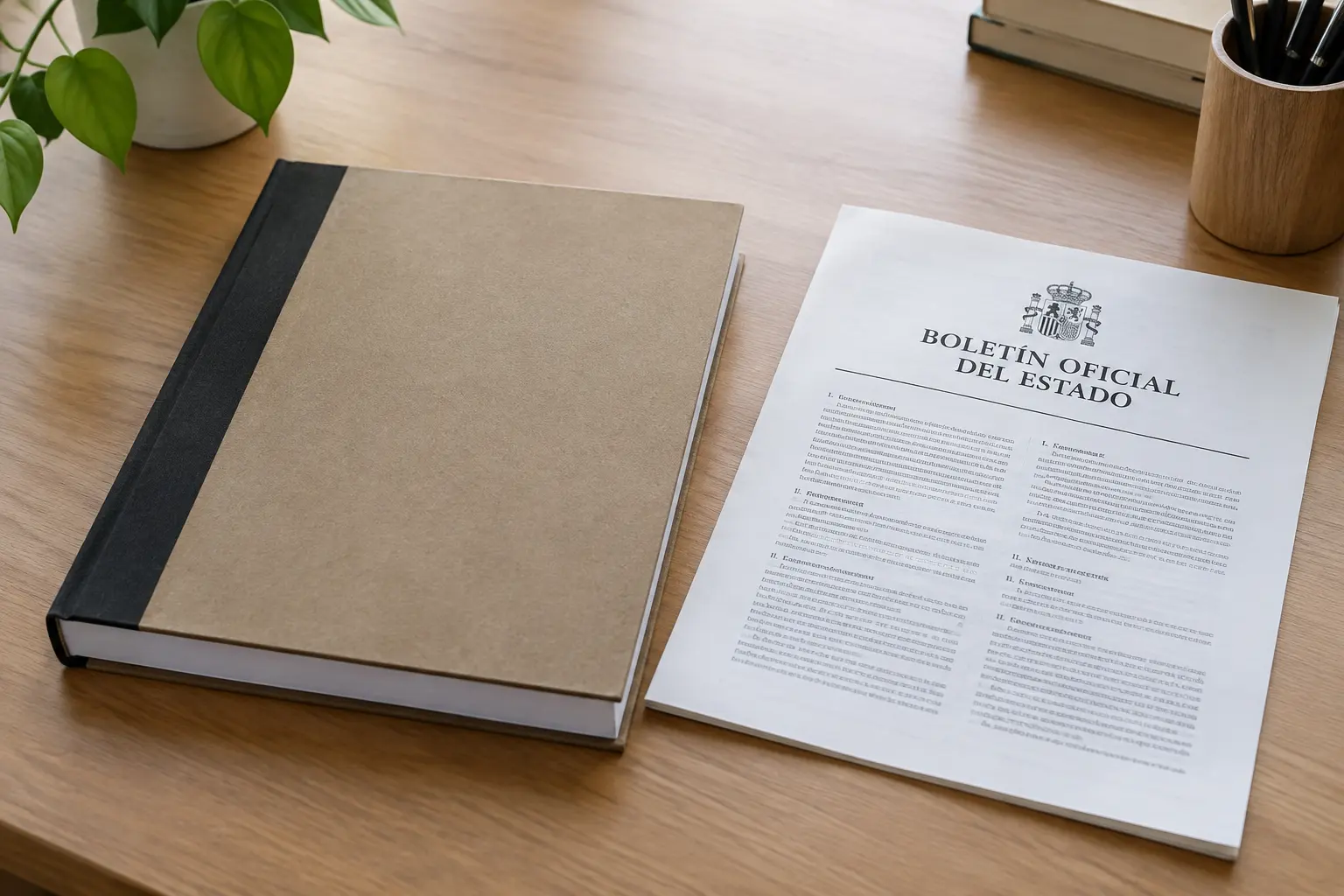
Three prior pieces on this site have benchmarked named institutions’ own published doctoral requirements — MIT and Cambridge’s thesis format regulations, TU Delft’s propositions and plagiarism-scan requirements, and TU Munich’s supervisor-first admission gate. All three sit in the US, UK, Netherlands and Germany — three of this site’s five target markets. Spain is the fourth, and Universidad Complutense de Madrid (UCM), one of Spain’s largest public universities, is the institution reviewed here. Its own Escuela de Doctorado pages describe a doctoral regulation reissued on 29 October 2024 and published in the university’s official bulletin (BOUC) on 9 December 2024, a two-stage electronic deposit process, and a set of physical-presentation rules that read closer to a bookbinding specification than a submission checklist. That combination — a recently reissued central regulation plus unusually specific physical-format rules — is the useful new data point this fourth benchmark adds.

Why a fourth benchmark, and why UCM specifically
MIT’s thesis specifications are a format-and-submission document. Cambridge’s published rules are a word-limit regime set by Degree Committee. TU Delft’s doctoral regulations add a propositions requirement and a mandatory pre-approval plagiarism scan run by the library. TUM’s pages answer an admissions-sequencing question — whether a candidate needs a named supervisor before applying at all. UCM’s own pages answer a different question again: once a candidate is admitted and has written the thesis, what does the university require of the physical and electronic object it will archive, and through how many formal steps does that object have to pass before a defence can be scheduled? UCM’s presentation norms and general doctoral regulation describe a governance model built on two-stage electronic deposit and Academic Commission sign-off rather than a single library check. Spain also sits inside a national framework the other three markets in this series do not share directly: Royal Decree 99/2011 sets minimum requirements every Spanish public university’s doctoral regulation must satisfy, so UCM’s own rules are best read as one university’s implementation of a shared national floor rather than a fully independent policy the way MIT’s or Cambridge’s largely are. A policy team benchmarking Spain more broadly should expect other Spanish universities to share UCM’s general structure — admission, development and evaluation stages, an Academic Commission per doctoral programme — while differing on the institution-specific detail this piece documents, such as the exact binding material and cover content.
| Institution | Country | What its own published rules are mainly about |
|---|---|---|
| MIT | US | Thesis format and submission specification (title page, abstract length, file format) |
| Cambridge | UK | Word-limit regime by Degree Committee, with a formal exceptions process |
| TU Delft | Netherlands | Propositions requirement and a mandatory pre-approval plagiarism scan |
| TUM | Germany | Admission-gate design (supervisor-first), doctoral pathway typology, fee model |
| UCM | Spain | Two-stage electronic deposit, Academic Commission approval, detailed physical-binding and cover specification |
The legal basis and the current edition
UCM’s doctoral regulation develops the framework set by Spain’s Royal Decree 99/2011 of 28 January, the national instrument governing official doctoral programmes, and covers admission, development and evaluation of doctoral theses at the university. The version currently in force on UCM’s own Escuela de Doctorado pages, at the time of writing, is the “Normativa de Estudios de Doctorado UCM” dated 29 October 2024, published in the university’s Boletín Oficial (BOUC) on 9 December 2024. UCM’s pages also reference an earlier permanence regulation from 26 October 2016, with one point amended by the Governing Council in June 2018, which continues to apply to students admitted before the 2023–24 academic year — a detail worth flagging to any policy team assuming a single regulation edition applies uniformly across a whole doctoral cohort. A named-institution benchmark is only as useful as its edition date; a committee citing UCM’s rules should confirm it is working from the 29 October 2024 text or whatever has superseded it by the time it reads this.
What the physical presentation rules actually require
UCM’s own presentation-and-binding norms are more specific than anything the three prior benchmarks in this series documented. The bound copy must be “encuadernado en tamaño A4” — bound in A4 size — using “cartulina, piel, cartón o cualquier material similar”, that is card, leather, board or a similar material, with the university’s own guidance actively discouraging spiral or comparable bindings on preservation grounds. The cover itself is specified down to its content: the university’s name and the candidate’s Faculty (not their department), the UCM coat of arms (with the partner university’s arms also permitted when the thesis is produced under co-tutorship with a foreign institution), the thesis title always given in Spanish — with English or the original language added where applicable — and the full name of the candidate and director or directors. One bound physical copy goes to the university Library; an electronic PDF version is submitted alongside it. UCM’s presentation norms state no page-count or word-count limit.
A two-stage electronic deposit, not a single submission
UCM’s process names two distinct electronic steps rather than one submission event: “trámite 1”, in which a provisional version of the thesis PDF is deposited, and “trámite 2”, in which the final version is submitted for authorisation by the Academic Commission of the specific doctoral programme. That two-step structure functions as a built-in checkpoint before the version that will actually be archived and defended is locked in — a provisional draft can still be corrected between trámite 1 and trámite 2 without restarting the whole deposit process. For a policy team comparing submission workflows, this is a materially different shape from TU Delft’s single mandatory pre-approval plagiarism scan or MIT’s title-page-and-format checklist: UCM’s gate is institutional sign-off by a named committee at a defined second step, not a single automated check run once.
What a two-stage, committee-gated deposit would ask of your own process
Adapting any element of UCM’s model is an operational question before it is a policy one. Three questions tend to surface once a committee looks at this seriously. First, who sits on the equivalent of an Academic Commission at your own institution, and does that body currently review a thesis’s final PDF before submission, or only its earlier proposal stage — UCM’s trámite 2 step is explicitly a second, later checkpoint, not a proxy for an earlier ethics or proposal approval. Second, what happens administratively to a thesis that fails at trámite 2 after passing trámite 1 — UCM’s presentation page describes the two steps without detailing the specific consequences of a trámite 2 rejection, which is exactly the kind of edge case a policy team adapting this model would need to define for itself rather than assume. Third, does your own binding-and-cover specification exist at all as a written document, or only as an informal convention library staff enforce case by case — UCM’s explicit, written cover-content rule (Faculty name, coat of arms, Spanish-first title convention) is a low-cost governance artefact any institution could produce even without adopting anything else from this benchmark.

What UCM’s published pages do not specify
In the same spirit as this series’ earlier treatment of TU Delft’s and TUM’s own gaps: UCM’s general doctoral regulation page and its presentation-and-binding norms page do not state a page or word-count limit for the thesis itself, do not detail the composition or size of the defence tribunal, and do not set out an institution-wide plagiarism-detection or AI-use policy for doctoral submissions. That is a different disclosure posture from TU Delft, whose own regulations name a mandatory pre-approval library plagiarism scan explicitly. This does not mean UCM has no such policy — a plagiarism or AI-use policy for doctoral work may sit in the full regulation text or in a separate document — only that those two summary pages do not state one, and a policy team citing UCM’s practice on integrity screening specifically should open UCM’s own current regulation PDF directly, via the Escuela de Doctorado’s normativa pages, rather than relying on a secondary summary.
Using this as a fourth data point, not a template
The value of this benchmark series is not that any one institution’s rules should be copied wholesale. It is that a committee drafting or revising its own doctoral policy can see, in each institution’s own published language, how differently the same underlying questions get answered — format specificity, deposit staging, admission sequencing, fee model — and can use that spread to test whether its own draft policy is a deliberate choice or an unexamined default. UCM’s explicit cover-content rule and two-stage deposit are the two elements from this benchmark most worth raising in a policy discussion, whatever the eventual decision. A team running a broader review of institutional length and format conventions may also find it useful to compare UCM’s presentation rules against the cross-country norms surveyed in this site’s discipline-by-discipline thesis length regulations piece, since a format specification and a length limit are governed separately even at the same institution.
Where Tesify fits
None of the deposit-staging, committee-composition or fee decisions above are ones a writing platform touches — they stay with the graduate school, the Academic Commission and the Faculty. Where Tesify is relevant is earlier and narrower: it is a thesis-writing workspace already used by 9,000+ students across more than 15,000 chapters, and every chapter in it is 100% written by the candidate. For a graduate school, that authorship position is the point to test — a programme can review how the platform would sit alongside its own supervision and deposit steps before recommending it to any cohort.
Frequently asked questions
What makes UCM a useful fourth institutional benchmark alongside MIT, Cambridge and TU Delft?
It is the first Spanish institution in this series, and its own published rules centre on a two-stage electronic deposit gated by Academic Commission sign-off plus an unusually specific physical binding-and-cover specification — a different governance shape from the word-limit regimes, single plagiarism scans or admission-gate designs the other three institutions publish.
What is the legal basis for UCM’s doctoral regulation?
UCM’s doctoral regulation develops Spain’s Royal Decree 99/2011 of 28 January, the national instrument governing official doctoral programmes, covering admission, development and evaluation of doctoral theses at the university.
What edition of UCM’s regulation is currently in force?
The “Normativa de Estudios de Doctorado UCM” dated 29 October 2024, published in the university’s official bulletin (BOUC) on 9 December 2024, as stated on UCM’s own Escuela de Doctorado pages at the time of writing. An earlier permanence regulation from 2016, partly amended in 2018, continues to apply to students admitted before the 2023–24 academic year.
Does UCM specify a page or word limit for the thesis?
Not in its presentation-and-binding norms. Those norms cover physical format, binding material and cover content in detail but state no length limit.
What does UCM’s two-stage electronic deposit actually require?
A provisional thesis PDF at “trámite 1”, followed by a final version submitted at “trámite 2” for authorisation by the Academic Commission of the specific doctoral programme, alongside one physically bound A4 copy sent to the university Library.
Did UCM’s pages specify an AI-use or plagiarism-scan policy for doctoral submissions?
Not on its general regulation summary page or its presentation norms. That is a different disclosure level from TU Delft, whose own regulations state a mandatory pre-approval library plagiarism scan by name. A policy team should confirm UCM’s current position directly with the Escuela de Doctorado rather than assume either way.
How should a policy team use a benchmark like this one?
As one documented data point in a small, named-institution set, useful for testing whether a committee’s own draft doctoral policy is a deliberate choice or an unexamined default — not as a template to copy without adapting to the reader’s own governance structure.