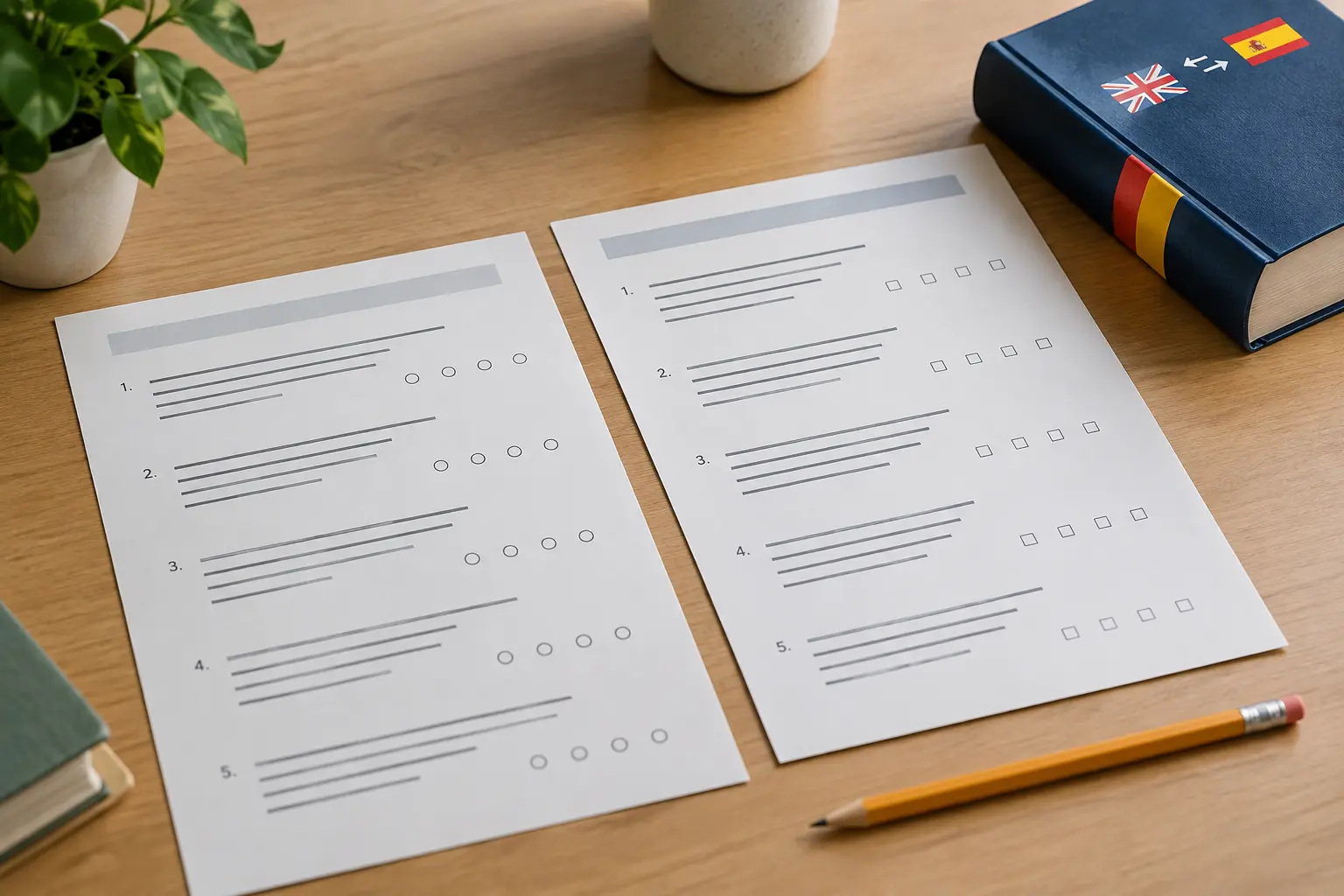
A psychology department that supervises thesis students across several language communities will meet the same problem every spring: a student finds a validated scale in English, translates it over a weekend, collects data from two hundred respondents and reports a Cronbach’s alpha as proof that everything worked. The viva then turns on a question nobody asked at proposal stage: what evidence shows that the translated items mean the same thing to the new respondents? By then the data are collected, the cohort is behind schedule and the supervisor is negotiating a revision. This piece sets out why the problem recurs, what the published guidance says, and a faculty standard that moves the conversation to proposal stage, where it costs a meeting and not a semester.
Why does the problem keep recurring?
Three conditions combine. First, most published measures of self-reported psychological and health constructs were developed in one language, so any student working with a different population meets the issue. Second, the literature on translation is fragmented. The ISPOR Task Force report on translation and cultural adaptation (Wild and colleagues, Value in Health 8, 94–104, 2005) states in its abstract that the task group identified a general lack of consistency in current methods and published guidelines, and set out to synthesise the full spectrum of published methods into principles of good practice. Third, a student can run a translation in a weekend and a reliability coefficient in an hour, so the visible evidence looks adequate even when it is not.
For a faculty the consequence is uneven supervision. One supervisor demands a forward and back translation, another accepts a bilingual colleague’s reading, and a third has never been asked. A department standard removes that variation.
What does the published guidance say?
A standard reference is Beaton, Bombardier, Guillemin and Ferraz, “Guidelines for the process of cross-cultural adaptation of self-report measures”, Spine, 25, 3186–3191 (2000). A university lecture summary of that process, from King Saud University’s rehabilitation sciences department, lists six stages, which are reproduced here as the checklist a faculty can adapt. The core sequence of forward translation, synthesis, back translation, expert committee review and pretesting is also how published adaptation studies that follow Beaton and colleagues describe their method; the committee size and other details below come from the summary:
| Stage | What the summary describes | Artefact the student should hold |
|---|---|---|
| 1. Forward translation | At least two independent bilingual translators whose mother language is the target language and who have distinct backgrounds (one informed about the construct), working independently | Written report of difficulties and choices for each translation |
| 2. Synthesis | A third independent translator compares the two versions with each other and with the source and reaches consensus | The synthesised preliminary version and a record of discrepancies |
| 3. Back translation | Two translators whose mother language is the source language, blind to the original, translate the preliminary version back | Two back-translations with written reports |
| 4. Expert committee | A multidisciplinary committee of 6 to 10 members, including a methodologist, health and language professionals, the translators and, where possible, the developer, compares versions on semantic, idiomatic, experiential and conceptual equivalence | Committee minutes and the pre-final version |
| 5. Test of the pre-final version | Field test with people whose language is the target language, checking clarity of instructions, items and response format | Pretest log with respondent comments |
| 6. Submission of documentation | The record of all steps is submitted to the developers or coordinating committee for appraisal | The full adaptation file |
The same summary adds a further stage of full psychometric testing in the target population to refine items and establish reliability and validity. A faculty should read the original paper, not only a summary, before adopting a standard. The table is a working description, not a substitute.
Is a perfect translation the goal?
Not necessarily, and a faculty standard should not demand the impossible. Evans, Paz and Mascialino (2021) in Frontiers in Psychology, writing about the CORE-OM outcome measure across Spanish language variants, argue that the translation literature tends to hold a questionable assumption about the possibility of exact translation and ignores variation within a language. They also note that the large-sample tests of measurement invariance often used after translation may not be relevant to outcome measures used in psychotherapy research. Their three-part study found qualitative evidence that one item was not ideal in the new context, but a quantitative exploration showed that changing it had a small impact on the overall score, which allowed retention of the existing Spanish translation. They argue that the myth of perfect translation and over-reliance on large-sample testing limit exploration of language effects, and they recommend sequential, user-based mixed-method exploration.
The implication for supervisors is balanced. The staged process produces documentation and catches gross errors, while mixed-method checks with real respondents show whether an imperfect item matters. A student who combines both, and who reports honestly what was found, has a stronger thesis than one who claims a flawless translation.
What does the failure cost the department?
- Revision time. A methods concern raised after data collection can mean new data, not new wording.
- Supervisor time. Each ad hoc conversation about an informal translation repeats work a standard would settle once.
- Examiner confidence. A thesis that cannot show how an instrument was adapted invites doubt about every result that depends on it.
- Comparability. Students in the same department who translate the same scale differently produce results that cannot be compared or pooled.
- Reputation. External examiners see the department’s standard through the quality of its theses.
What should a faculty standard require?
- Check for an existing translation first. Before any new translation, the student searches for a published, validated version in the target language and asks the developer or publisher. Where the instrument is licensed, the licence and any translation terms come first, as discussed in the guidance on supervising a thesis on burnout.
- Permission to adapt. The student secures written permission from the developer or publisher before producing a new version.
- A proportionate process. A full staged process for a main instrument; a documented review by two bilingual colleagues and a pretest for a minor background measure. The proposal states which applies and why.
- A named adaptation file. The artefacts in the table are kept together and submitted with the ethics application or proposal.
- Evidence on the thesis sample. Reliability and, where design permits, further validity evidence are computed on the thesis’s own sample, following the checklist in the guide to teaching students to validate a thesis instrument.
- Honest reporting. The methods chapter reports every change, every disagreement the committee resolved and any item the pretest flagged.

How does the standard fit the ethics route?
Adaptation work usually involves participants at the pretest stage, so the ethics application should describe it. A tiered route, such as the risk-tiered pathway described in the guide to an ethics and access review for thesis research, can treat the adaptation pretest as low risk where the instrument is not sensitive, and require fuller review where the measure asks about distress. The department should also decide who may serve on the expert committee, so that a student does not depend on one favoured colleague.
Who should own the standard?
A methods lead or research-degrees committee should own the standard and review it each year. Responsibilities are simple. The methods lead keeps a register of adapted instruments the department has already approved, so that a second student does not repeat the work, and maintains a list of bilingual staff willing to serve on committees. The graduate school confirms that the standard is applied to every proposal that uses an instrument in a language other than the one it was developed in.
A register is the quickest return on effort. If one student has already adapted a scale and the department holds the file, a later student can build on it, subject to permissions, and add their own sample evidence instead of starting again.
What do students need in practice?
Students need a template, a timeline and a sense of proportion. A template for the adaptation file shows what each stage produces. A timeline, usually a few weeks for a staged process, should sit in the proposal schedule, not appear as a surprise. And a short guide explains what a minor background measure requires compared with a primary outcome measure. When these are in place, the conversation at the proposal meeting becomes a review of a file and not a debate about opinions.
What does a one-term rollout look like?
A department does not need a new committee to start. In the first month the methods lead drafts the one-page standard and the adaptation-file template, and circulates both to supervisors with a short note on the proportionate rule. In the second month the research-degrees committee adds a single question to the proposal form: is any instrument being used in a language other than its original, and if so, which route applies? In the third month the first proposals arrive with adaptation files, and the methods lead reviews them against the table above, recording recurring problems such as missing permissions or an expert committee made up of one person. By the end of the term the department has a register of approved adaptations, a list of bilingual reviewers and a set of worked examples to share with the next intake. The cost is a few hours per proposal at the point where the answer is easiest to change.
Where Tesify fits
Whether an instrument adaptation is adequate is a judgement for the supervisor and the faculty’s methods lead. Once a student is writing up the study, Tesify helps students structure and organise their thesis while they write 100% of the work themselves: more than 9,000 students have written over 15,000 chapters with Tesify. See how Tesify supports a thesis cohort.
Frequently asked questions
Is a translation by the student enough for a thesis instrument?
Usually not. A thesis should show a documented adaptation process and evidence on its own sample. A single informal translation leaves open whether items mean the same thing to new respondents.
What stages does a standard adaptation process include?
According to a university summary of Beaton and colleagues, six stages: forward translation, synthesis, back translation, expert committee review, test of the pre-final version and submission of documentation, followed by psychometric testing.
Why does the ISPOR report matter?
Its abstract describes a general lack of consistency in current translation methods and guidelines and a consensus on principles of good practice for patient-reported outcome measures. It shows why a faculty needs a written standard.
Does a translated scale need permission?
Where the instrument is copyrighted or licensed, the developer or publisher should be asked before a translation is produced. The faculty standard should require written permission in the proposal.
Is perfect translation possible?
Evans, Paz and Mascialino (2021) argue that the assumption of exact translation is questionable and that mixed-method exploration of whether an imperfect item matters is more useful than pursuing perfection.
Can a thesis rely on the published reliability of the original scale?
No. A translated version is a new instrument for a new population, so the thesis should compute reliability and other evidence on its own sample.
How large should the expert committee be?
The university summary describes a multidisciplinary committee of six to ten members including a methodologist, professionals, the translators and the developer where possible.
Does every instrument need the full process?
A faculty can set a proportionate rule: a full staged process for the main instrument and a lighter documented review for a minor background measure, with the proposal stating which applies.
Who should keep the adaptation file?
The student keeps it and submits it with the proposal. The department keeps a register of approved adaptations so later students can build on them, subject to permissions.
When should the standard be applied?
At proposal stage, before ethics submission and before any data are collected, so that problems are fixed when they are cheapest.