
Most thesis-format policy work starts from a blank page or an inherited document nobody can trace to a decision. A faster starting point is reading what two research-intensive institutions actually publish and require, then adapting the parts that fit your own governance structure. This is a direct read of MIT’s published thesis specifications and Cambridge’s published PhD word-limit policy — not a summary of what either is rumoured to require, but what their own current guidance pages state. It sits alongside how many doctoral theses are produced each year as a companion reference for a graduate school sizing its own examination workload against comparable institutions.
Why benchmark against named, currently published regulations

A policy team drafting or revising a thesis-format regulation faces a familiar problem: the previous version was written years ago by people no longer in post, and nobody can say which clauses were a deliberate decision and which were copied from somewhere else without checking. Reading two current, publicly published regulations from named institutions side by side gives a policy committee something to react to concretely — “do we want a hard word cap like Cambridge’s, or an open structure like MIT’s” is a decision a committee can actually make, where “should our thesis policy be modernised” is not.
MIT: format-and-structure regulation, no hard word cap
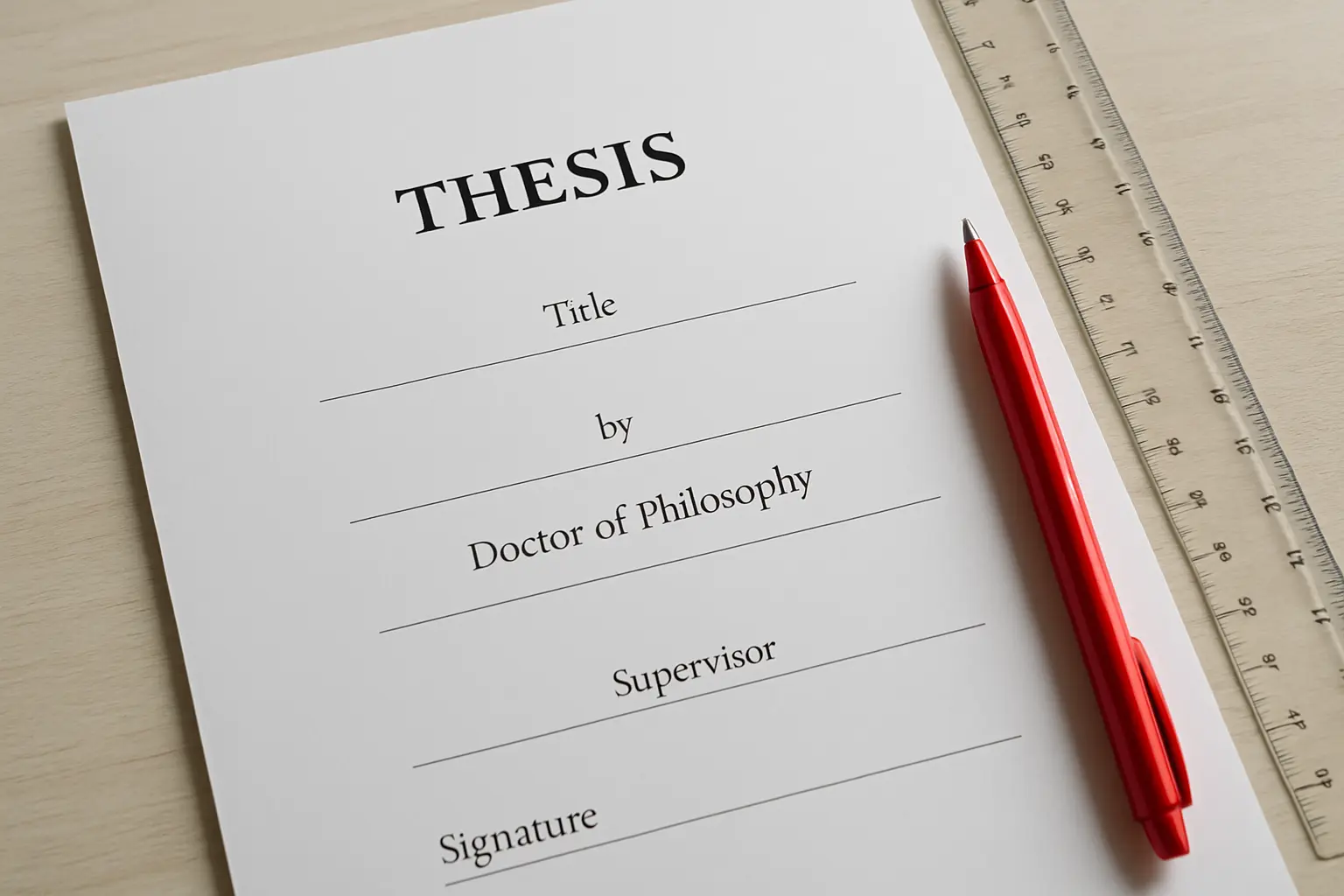
MIT Libraries’ published thesis specifications set structural and technical requirements rather than a length limit. The title page must include the thesis title, author name, previous degrees, the degree to be awarded, the conferral date, a copyright notice, and the names of the thesis supervisor and program officer — all on a single page. The abstract is capped, not the thesis: MIT specifies the abstract should be “generally no more than 500 words single-spaced.” Pagination must run in one consecutive sequence across the entire document, including prefatory material and appendices, and the required submission format is PDF/A-1, which MIT’s guidance describes as the more suitable format for long-term preservation than a basic PDF. A signature page is explicitly not required, though individual departments may still request one — sign-off instead runs through supervisor certification and program-officer acceptance on the title page itself. Departments must transfer completed theses to the library within 30 days of the last day of class, which functions as MIT’s practical submission deadline structure.
Cambridge: a hard word cap, enforced departmentally, with a declared exceptions process
Cambridge’s published guidance for the PhD, and equivalent research degrees, takes the opposite approach: it sets an explicit word ceiling rather than a structural specification. Most PhD programmes cap the thesis at 80,000 words, though this varies by Degree Committee — Physics, for example, sets a lower limit. What counts toward that ceiling is not standardised across the university: History’s guidance excludes the contents page, abstract, acknowledgments, footnotes and references from the count, while other departments include or exclude appendices and footnotes differently. Exceeding the limit requires advance approval through the university’s self-service system, ideally submitted three to four months before thesis submission, and Cambridge’s own guidance states plainly that “permission to exceed the prescribed limits will be granted only in the most exceptional circumstances” — a thesis over the limit without prior approval may not be examined until it complies. A signed declaration attesting to the thesis length accompanies submission.
Where the two diverge, and what it tells a policy team
| Dimension | MIT (published thesis specifications) | Cambridge (published PhD word-limit policy) |
|---|---|---|
| Primary control | Structural and formatting requirements | Hard word-count ceiling |
| Length limit | None specified for the thesis body; abstract capped at ~500 words | Typically 80,000 words, varies by Degree Committee |
| What counts toward the limit | Not applicable — no thesis-body cap | Varies by department; some exclude footnotes and appendices, others include them |
| Exceptions process | Not applicable | Advance approval via self-service, 3–4 months ahead; granted only in exceptional circumstances |
| Sign-off mechanism | Supervisor certification and program-officer acceptance on the title page; separate signature page not required | Signed candidate declaration on thesis length; examiner appointment handled through a separate application |
| File format requirement | PDF/A-1 specified explicitly | Electronic submission, A4 portrait; format specification not addressed in this guidance page |
The practical takeaway for a policy team is not that one model is correct — it is that both are internally consistent choices a committee can name and defend. A structural specification without a length cap (MIT’s approach) puts the length decision entirely in the supervisor’s and examiner’s judgement; a hard cap with a formal exceptions process (Cambridge’s approach) trades that flexibility for predictability and equal treatment across a large, decentralised collegiate university. Which trade-off fits your own institution depends more on how centralised your examination process already is than on which regulation reads more rigorous on paper.
What neither publishes: a generative-AI use policy inside the thesis-format regulation itself
Neither MIT’s thesis specifications page nor Cambridge’s word-limit and requirements page addresses generative AI use in thesis writing. This is a genuinely useful negative finding for a benchmarking exercise: it indicates that, at both institutions as of this guidance, AI-use policy for thesis writing sits in a separate academic-integrity or departmental policy document rather than inside the format-and-submission regulation. A policy team benchmarking against either institution should not assume silence in the format regulation means no AI policy exists at all — it means the two questions are being governed as separate documents, which is itself a structural decision worth deciding deliberately rather than by default.
A benchmarking checklist for your own thesis-format regulation

| Question | MIT’s answer | Cambridge’s answer |
|---|---|---|
| Is there a hard length cap? | No | Yes, ~80,000 words, department-dependent |
| Is the abstract separately capped? | Yes, ~500 words | Not addressed in this guidance |
| Is a signature page required? | No (certification via title page instead) | Not addressed in this guidance; declaration on length is required |
| Is there a defined exceptions process? | Not applicable | Yes, formal, with a lead time and exceptional-circumstances bar |
| Is a specific file format mandated? | Yes, PDF/A-1 | Not addressed in this guidance |
Run your own regulation through the same five questions before a revision goes to committee. Where your answer is silent rather than deliberate, that is the clause most likely to generate an inconsistent decision the next time a borderline case reaches an examiner.
Running your own benchmarking exercise in four steps
A benchmarking exercise built on this comparison is straightforward to replicate against your own peer institutions, and it does not require a large committee to run: first, identify two to four peer or aspirational institutions whose thesis-format regulation is publicly published on their own graduate school, library or degree-committee website — a page you can WebFetch or read directly, not a summary someone else wrote about it, because paraphrased summaries drift from the source over successive committee meetings. Second, extract the same five to seven dimensions used in the checklist above from each — length control, abstract limit, signature requirements, exceptions process, file format, AI-use policy location — so every institution is compared on identical questions rather than whatever each publishes prominently. Third, mark explicitly where your own current regulation is silent on a dimension a peer institution addresses, since a silent clause is not a neutral position, it is an unwritten policy that different supervisors and examiners will interpret differently in practice. Sizing the committee’s time against how many candidates this actually affects is worth doing early — see postgraduate enrolment by field of study for the cohort volumes a format-regulation change would touch. Fourth, bring the comparison table, not a narrative summary, to the policy committee — a table lets the committee vote dimension by dimension rather than accepting or rejecting an entire redraft as one block, which is both faster and produces a decision the committee can actually explain afterward to the faculty it governs.
Common mistakes when importing another institution’s regulation wholesale
The most common failure mode in this kind of benchmarking work is copying a peer institution’s clause without checking whether the surrounding governance structure that makes it workable actually exists at your own institution. Cambridge’s hard word cap works inside a collegiate structure with Degree Committees that already own subject-specific exceptions processes and a central self-service system that logs and tracks approval requests — importing the cap without the committee structure or the tracking system produces a rule nobody enforces consistently, which is worse for institutional credibility than no cap at all. Equally, MIT’s open, no-cap structural model relies on supervisor and program-officer sign-off carrying real weight and real accountability at the point of submission; importing the no-cap approach without that accountability layer in place risks length creep with no mechanism to catch it until an examiner raises it late in the process, by which point revising it is far more disruptive to the candidate than a length limit flagged at the proposal stage would have been. The safe approach is always to adopt the underlying governance logic — who decides, on what evidence, with what recorded accountability — rather than the surface clause on its own.
Where Tesify fits
Once a format regulation is set, enforcing it consistently across every submission is a separate operational problem from writing the policy itself. The Tesify Citation Engine for Institutions applies your faculty’s house formatting and citation style automatically as students draft, which reduces the volume of format-only returns a deposit desk or examiner has to issue for a technical fix rather than a substantive one. A free departmental pilot lets a graduate school test this against one submission cycle before any procurement commitment.
Frequently asked questions
Does MIT set a maximum thesis length?
MIT’s published thesis specifications do not set a length limit for the thesis body. The one explicit length control is the abstract, which the guidance states should generally be no more than 500 words, single-spaced.
What is Cambridge’s standard PhD word limit?
Most Cambridge PhD programmes cap the thesis at 80,000 words, though the specific limit and what counts toward it varies by Degree Committee — some departments, such as Physics, set a lower limit, and inclusion of footnotes and appendices is not standardised across departments.
Can a Cambridge candidate exceed the word limit?
Only with advance approval, submitted through the self-service system ideally three to four months before submission. Cambridge’s own guidance states permission is granted only in the most exceptional circumstances, and an unapproved over-length thesis may not be examined until it complies.
Does either institution’s thesis-format regulation address generative AI use?
No. Neither MIT’s thesis specifications page nor Cambridge’s word-limit and requirements page addresses AI use — at both institutions this appears to sit in a separate academic-integrity policy rather than the format regulation itself.
Does MIT require a signed signature page from examiners?
No. MIT’s guidance states a signature page is not required, though individual departments may still request one. Certification instead runs through the thesis supervisor and program officer on the title page.
What file format does MIT require for thesis submission?
PDF/A-1, which MIT’s guidance describes as more suitable for long-term preservation than a basic PDF.
Is this comparison the same as the national page-and-word conventions by discipline?
No — see thesis length regulations by discipline for national and discipline-level conventions. This piece instead walks through two specific named institutions’ own currently published regulations, which is a different and more granular benchmarking exercise.
How many peer institutions should a benchmarking exercise compare?
Two to four is usually enough to surface genuine divergence without producing a table so large the policy committee cannot act on it. Choose institutions whose governance structure resembles your own — a centralised university benchmarks more usefully against another centralised university than against a large collegiate one with devolved Degree Committees.
Should a graduate school adopt Cambridge’s hard word cap or MIT’s structural approach?
Neither is universally correct. A hard cap suits an institution that already has (or is willing to build) a tracked exceptions process and a body empowered to grant them; an open structural approach suits an institution where supervisor and examiner sign-off already carries real accountability. Match the clause to the governance structure you actually have, not the one you wish you had.