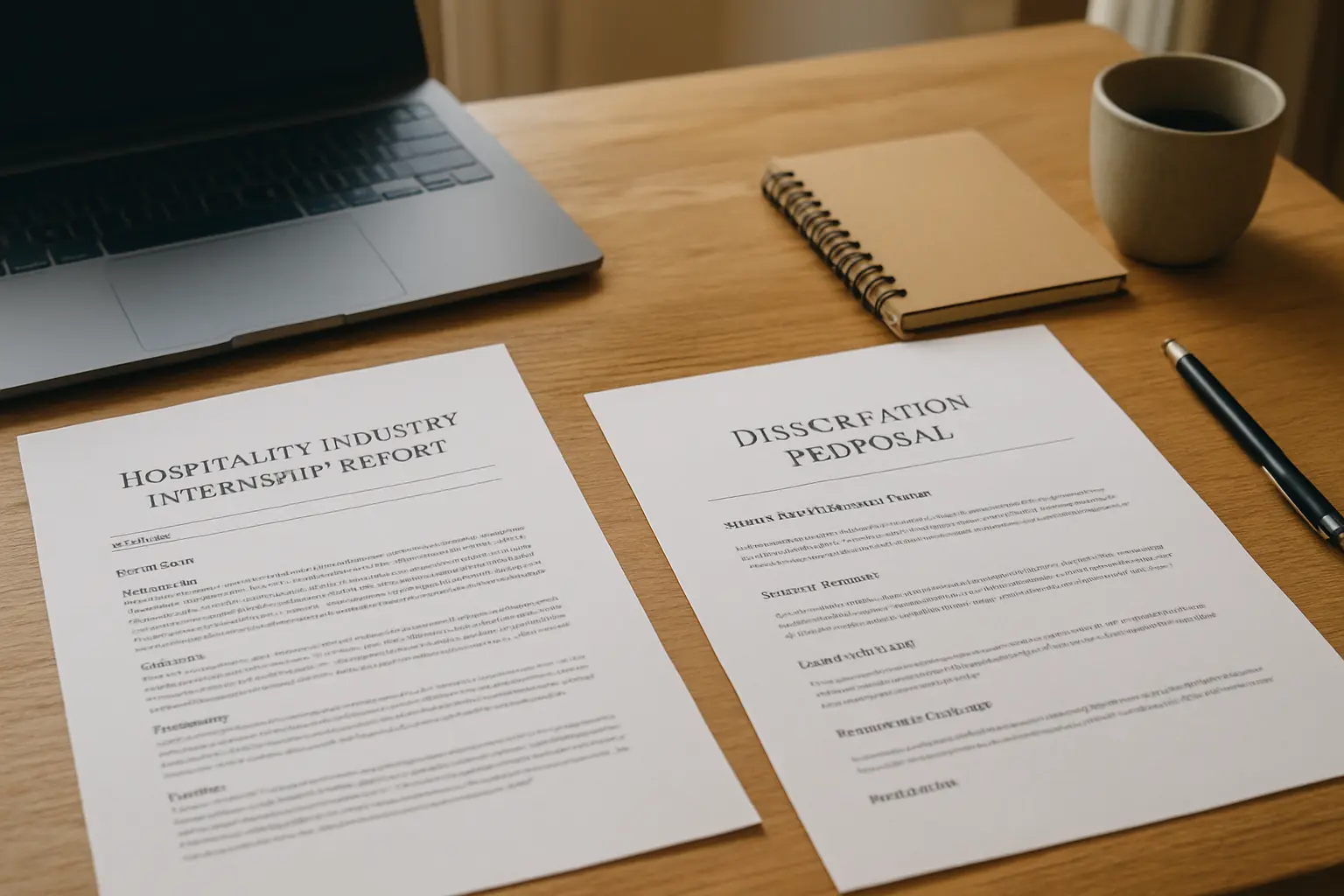
A tourism or hospitality student spends a semester on industry placement, writes a detailed internship report their workplace supervisor signs off on, and then turns straight into writing a dissertation — and at exactly that handoff, the writing support stops. The industry supervisor was never an academic-writing coach and was not meant to be one; the university writing centre never saw the internship report and has no idea what the student actually did or how well they wrote about it. The gap is not a lack of willingness on either side. It is that nobody owns the transition itself.
Why this handoff is worse than a normal thesis start

Most dissertation students arrive at the writing stage having spent the previous term in seminars and supervision meetings, actively building academic-writing habits. A tourism or hospitality student coming off a placement has spent the same months in an operational role — running a front desk, managing a food and beverage outlet, coordinating a tour operation — writing operational reports, incident logs and a placement reflection document assessed on professional competency, not academic argument. The transition from that register to a dissertation’s expected structure, critical engagement with theory, and citation discipline is a bigger jump than a standard taught-masters student makes, and it happens at exactly the point when supervision hours are thinnest, because the academic supervisor has typically had minimal contact with the student during the placement term itself.
Why hospitality programmes feel this more than most
A hospitality management or tourism degree with a mandatory industry placement year — common in the UK sandwich-degree model and equivalent structures across many countries — builds this exact gap into the programme design: a full year (or a full semester in a shorter placement model) where the student is embedded in an operational environment with no routine academic-writing contact, followed immediately by a dissertation term where that muscle is expected to reactivate on demand. A programme that has not deliberately built a re-entry support step is relying on the student to make that jump alone, at the same time the dissertation clock has already started running.
The seasonal timing makes it worse again

Tourism and hospitality placements frequently run through the industry’s own peak season — summer for many destinations, the winter holiday period for others — which means the placement’s most demanding operational stretch often lands immediately before the academic term restarts, leaving little recovery time before the dissertation clock starts. This compounds the same seasonal capacity problem already documented generally in the masters dissertation season capacity cliff: a cohort returning from placement in a tight window arrives at the dissertation stage simultaneously, at the exact moment the writing centre and supervision capacity are least equipped to give each student individual re-entry support.
The scale of this varies by placement model. A programme running a full sandwich year sees its entire placement cohort return in one narrow window once a year, producing the sharpest version of this spike. A programme running shorter, staggered semester-length placements spreads the same re-entry problem across more points in the calendar, which is gentler on peak capacity but means the writing centre effectively never gets a season free of returning-placement students needing this specific kind of support. Neither model removes the underlying gap; each just distributes it differently across the year, which is worth mapping explicitly against your own placement structure rather than assuming the sandwich-year spike pattern applies universally.
A worked example: the same student, two very different documents
Consider a hospitality management student who spends a placement semester as a front-of-house supervisor at a resort during peak season, writing a weekly operational report for their placement manager covering staffing gaps, guest-complaint patterns and a service-recovery process they helped redesign. That report is detailed, honest and operationally useful — and it is written entirely in the register of an internal business document: short paragraphs, action items, no citations, no engagement with service-quality literature. Six weeks later the same student is expected to produce a dissertation proposal identifying a research question, situating it against academic literature on service recovery or guest satisfaction, and proposing a method — using, ideally, the same real operational problem they just spent a semester inside. Nobody has shown them how to take the service-recovery redesign they already documented and reframe it as a researchable question with a literature base behind it; the skill gap is not motivation or subject knowledge, it is a specific translation step between two registers that nobody in the current process owns.
Common failure modes in how programmes currently handle this
Three patterns recur. First, the programme assumes the returning student will simply pick up where a taught-masters student without a placement would be, and schedules the same proposal deadline for both groups — ignoring that the placement group has had months without academic-writing practice while the non-placement group has been continuously building it. Second, the placement report and the dissertation are treated as fully separate deliverables assessed by different people who never compare notes, so the dissertation supervisor often does not even read the placement report and has no visibility into what real material the student already has to work from. Third, where a re-entry workshop does exist, it is usually generic academic-writing refresher content rather than something that starts from the student’s own placement material, which means it teaches the skill in the abstract rather than applying it directly to the asset the student already has in hand.
What the placement report actually leaves behind
The internship report itself is not wasted effort — it typically contains a genuinely useful raw asset for the dissertation: real operational data, a documented industry problem, and the student’s own first-hand observations, all things a conventional literature-only dissertation student has to source separately. The gap is not access to material; it is that nobody has structured a bridge from “here is what happened on placement, written for an industry supervisor” to “here is a research question and a critical argument, written for an academic examiner.” Programmes that treat the internship report as a closed, filed document rather than raw material for the dissertation are leaving genuinely useful groundwork unused.
This is a field-specific instance of a support-transition gap that recurs at other stage boundaries across a graduate school. Your longest-registered candidates are the ones nobody is supporting documents the equivalent problem at the opposite end of a research programme — a support structure calibrated for an earlier stage that quietly stops fitting once a candidate moves into a different phase of the work. The placement-to-dissertation handoff in tourism and hospitality is the same structural failure at the start of the write-up process rather than the end of it: a support model built for one stage of the student’s journey that was never redesigned for the transition into the next one.
Where Tesify fits
This is exactly the kind of structural, repetitive writing-transition problem a supervised drafting tool is built to close. The Tesify AI Writing Editor for Institutions walks a returning placement student through converting their own internship observations into a structured dissertation research question and literature-engagement plan, inside a workspace the academic supervisor can see from the first draft — rather than the supervisor’s first real contact with the student’s writing being a rough full chapter weeks into term. The same Tesify for Institutions platform gives the writing centre a way to extend support to a placement cohort returning all at once, without needing to staff up for the peak the way the writing centre waiting list you cannot staff your way out of describes for the equivalent taught-masters peak. A free departmental pilot lets one returning placement cohort test this against your programme’s own re-entry gap before any procurement decision.
Frequently asked questions
What does this cost?
The departmental pilot is free and scoped to one returning placement cohort. Institutional licensing beyond the pilot is priced against your cohort size once the pilot shows a measurable improvement in how quickly students produce a workable dissertation draft after returning from placement.
Where is student data processed, and does that raise GDPR or FERPA concerns?
Data residency and processing terms are set out in the institutional data processing agreement provided before any pilot begins. A dissertation draft built from a student’s own placement observations is treated with the same data-protection rigour as any other student academic work — confirm the specific residency terms relevant to your jurisdiction with your procurement or data-protection office before the pilot starts.
Does this replace the academic supervisor’s role?
No. It structures the student’s own transition from placement observations to a dissertation research question, so the supervisor’s first review sees a genuine attempt at academic framing rather than an unstructured placement narrative, and supervision time goes to judging the argument, not prompting the student toward basic structure.
What is the integration effort for one cohort to pilot this?
Minimal. A departmental pilot does not require SSO or LMS integration to begin; returning placement students access the workspace directly, and a wider institutional rollout, if the pilot succeeds, is the point at which SSO and LMS integration become relevant.
Does using a structured drafting tool to convert placement material raise an academic-integrity question?
No. The tool prompts the student to specify their own research question and critical framing from their own placement observations; it does not generate the dissertation’s substantive argument, and every draft is visible to the supervisor exactly as any other supervised drafting stage would be.
Does this apply to programmes without a mandatory placement year?
The specific placement-to-dissertation handoff is sharpest where a placement year or semester is mandatory, but the underlying re-entry gap — moving from operational or professional writing back into academic register — applies to any tourism or hospitality student who has spent time away from routine academic-writing contact before starting the dissertation.
How is this different from the internship-thesis rubric already covered for social work?
That piece is an assessment-design question for a faculty building a marking rubric for a practicum-based thesis. This is an earlier, operational support gap — the writing-transition support a returning placement student gets (or does not get) before drafting even starts, in a field where the placement is typically industry-based rather than clinical or client-facing.
Should the placement report and the dissertation be assessed by the same person?
Not necessarily, and for the same reason it should not be assumed for a clinical or social-work placement: the industry supervisor’s competency-based sign-off and the academic supervisor’s research-quality judgement are different assessments. What should be shared is visibility — the academic supervisor benefits from reading the placement report as source material, even without formally co-assessing it.
What is the single highest-leverage fix a programme can make?
Building an explicit re-entry step that starts directly from the student’s own placement material — the operational problem, the data, the observations they already have — rather than a generic academic-writing refresher delivered in the abstract before the student has reconnected it to their own project.
Who should own building the re-entry step?
Ideally a joint effort between the placement office, which already has the calendar for when cohorts return, and the dissertation programme lead, who owns the proposal-approval timeline the re-entry step needs to feed into. Neither office alone typically has visibility into both halves of the problem.