
Look at your doctoral register and sort by registration date. The candidates at the bottom of that list are the most expensive students in the institution, the most likely to leave without an award, and the least likely to have been offered anything by any support service in the last eighteen months.
Not because anyone decided that. Because every service you run is calibrated for a cohort that arrives together, sits in a term-time timetable, and has a module leader. A candidate in year five has none of those things.
The stage where support quietly stops
Four supports fall away at almost exactly the same point, and they fall away together.
Funding ends. The stipend runs out before the thesis does, and the candidate takes work. Their available writing time collapses at the moment the writing task becomes largest.
Teaching ends. They are no longer in a cohort, no longer in a seminar, and no longer in front of anyone who would notice a stall.
They leave campus. Fieldwork finished, desk reallocated, and the writing happens in a kitchen in another city. A drop-in service with opening hours does not reach them.
Supervisory contact thins. Meetings that were fortnightly become quarterly, precisely when the document has grown past the length at which anyone can hold it in their head.
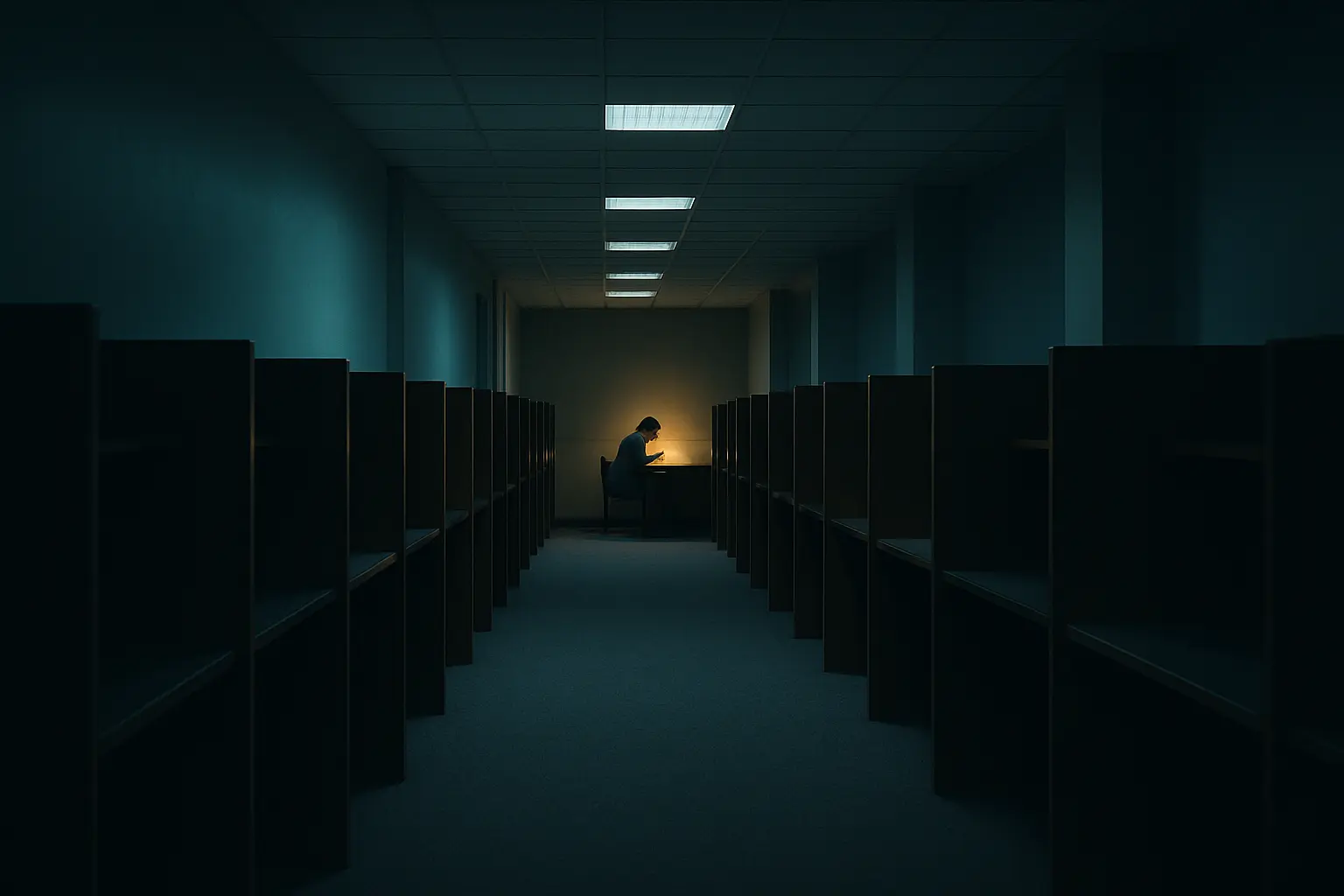
The writing centre is not at fault here. Its demand is generated by taught programmes and it is already oversubscribed by them, for the structural reasons set out in the waiting list you cannot staff your way out of. The doctoral tail is not competing for that capacity — it has stopped asking.
What the tail costs you
The cost is not the tuition line. It is four other things, none of which appears in one place.
Supervisory time spreads over a longer period without getting smaller: a candidate in year six still requires meetings, reports and progress reviews. Examiner scheduling is repeatedly deferred, and each deferral is administrative work. Continuation and writing-up registrations generate records, fee decisions and appeals. And the completion figures that a funder, a ranking or a research council reads are made almost entirely by this population, with all the caveats about what those figures actually measure that are set out in where graduate completion and attrition data comes from.
The order of magnitude is worth looking at directly. Dividing Germany’s 205,302 enrolled doctoral candidates in 2023 by the 28,171 doctoral examinations passed in 2024 implies a stock-to-flow ratio of about 7.3 — an upper bound on how long a registration lasts, and a long way above anyone’s nominal programme length. The sources and the caveats are in how many postgraduates, and how many staff to supervise them. Whatever your own figure is, the gap between it and your nominal duration is the population this article is about.
Why “more supervision” is not the fix on offer
It is the right answer and you cannot buy it. Academic staff numbers are broadly flat while doctoral enrolment rises — EU-27 doctoral enrolment grew 9.2 per cent between 2018 and 2023 — and no institution is about to appoint supervisors to reduce the load on a population that is already past its funded period.
What is actually available is to change what supervision time is spent on. Supervisors currently lose a substantial share of their review attention to structure, formatting and reference mechanics rather than to argument, which is the problem described in what your supervisors are actually reviewing. In the writing-up phase that ratio is at its worst, because the document is at its longest and the candidate has had the least recent contact with the conventions.
What Tesify for Institutions changes, feature by feature
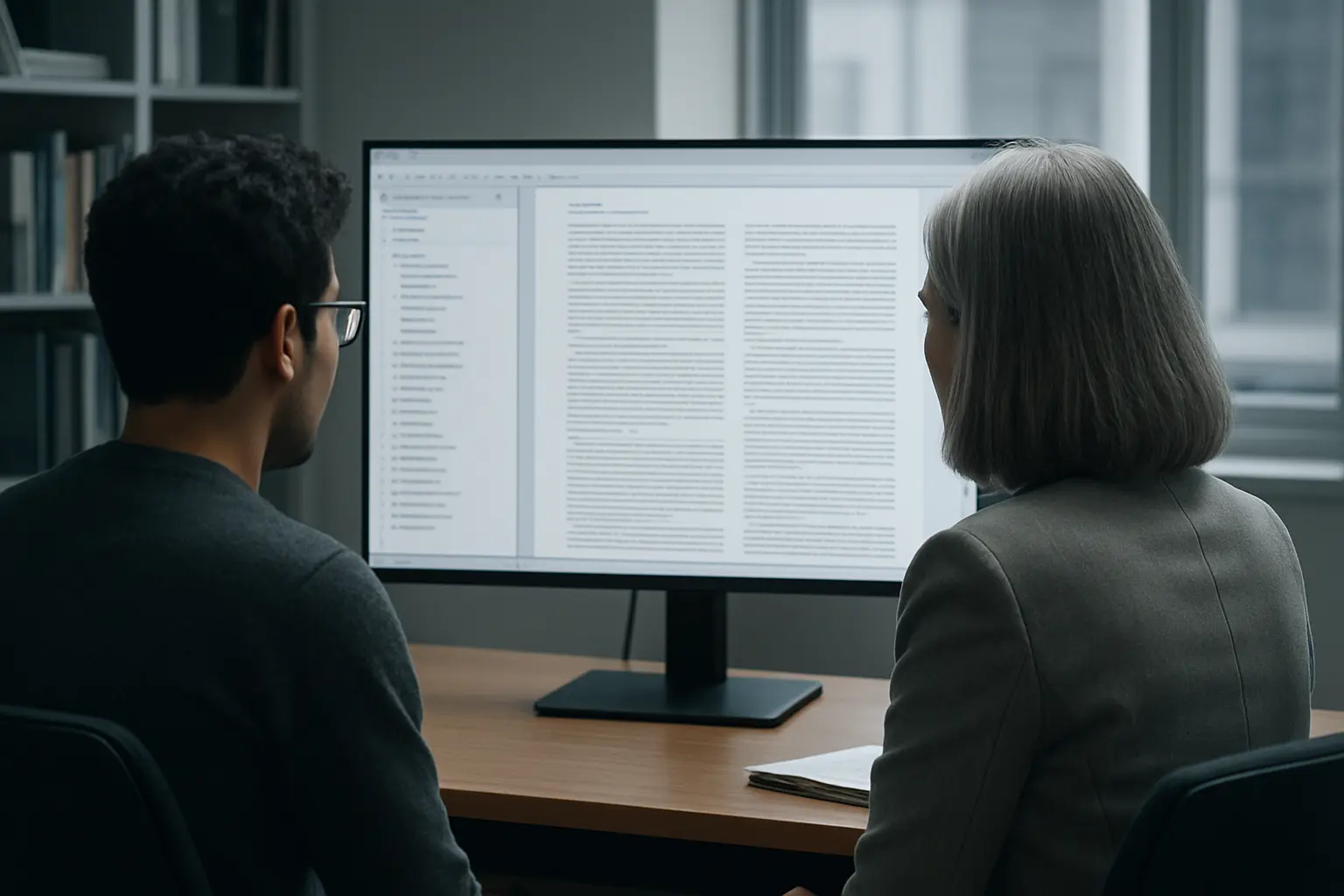
It works at thesis length, not at essay length. Chapter-level structural review across a 250-page document catches the things that actually stall a writing-up candidate: a methods chapter that no longer matches the analysis, a literature review written three years ago, inconsistent terminology across chapters drafted eighteen months apart. That is a task a supervisor currently does by reading the whole thing again.
It verifies references against the scholarly record. A source-verification rule is only enforceable if checking is cheap. Making every reference resolvable removes both the fabricated-citation risk and the single most tedious pre-submission task from the supervisor’s desk.
It produces the supervision record as a by-product. Drafts, comments and revision history accumulate where the writing happens rather than in an email thread, which is the process evidence an authorship question actually needs — the governance argument for it is in how AI rules should differ for a doctoral thesis.
It moves deposit readiness upstream. Formatting, metadata and structural compliance handled during writing rather than discovered at the deposit desk, where they currently cost candidates weeks and can move a conferral date — see your deposit desk is holding degrees for metadata.
It reaches people who are not on campus. The candidate in the kitchen in another city gets the same service as the one down the corridor, at the hour they are actually writing.
Start with the doctoral tail, not with the institution
This population is an unusually good pilot cohort, and that is a practical argument rather than a rhetorical one.
It is small and individually identifiable, so a baseline can be captured properly rather than estimated. It is high value, so any movement in submission timing is worth more per head than movement anywhere else in the institution. It has an obvious owner in the graduate school. It needs no LMS integration to get started, because these candidates are not in modules. And it produces a clean outcome measure that a finance committee already recognises: submissions within the period, and time from submission to award.
A free departmental pilot with the writing-up cohort of one faculty clears procurement in a way a purchase order does not, and the eleven steps and the criteria sheet are already written up in how to run a departmental pilot of an AI writing tool. Capture the baseline before you start; it cannot be recovered afterwards.
If you would like to scope a pilot with your own writing-up cohort — baseline measures, the graduate school’s outcome definitions, and the data protection position — request an institutional evaluation and we will work through it with your graduate school director.
Frequently asked questions
What does a pilot cost?
Nothing. A departmental pilot is free, scoped to one term and one cohort, and is deliberately structured so it can be declined at the end without a procurement decision having been made.
How long does it take to set up?
For a writing-up cohort, days rather than weeks. This population is not in modules, so nothing depends on LMS integration; a managed user list is enough to start, and single sign-on can follow if the pilot proceeds.
Where is the data processed?
Ask this of every supplier and get the answer in the contract rather than from a marketing page. We will state our processing locations, our sub-processors and our transfer position in writing as part of the evaluation, and we expect you to hold us to it.
How does this sit with GDPR and FERPA?
The deployment is processed under a data processing agreement, with the lawful basis, retention and training positions settled in writing before any candidate is enrolled. For US institutions the rights-holder question matters at university level and is not the one most people assume; the contract clauses to establish either way are set out in is student work used to train AI models.
Is student work used to train models?
No, and retention in a matching corpus is a separate permission from training — establish both in the contract rather than accepting a single reassuring sentence about either.
Does this create an academic integrity risk?
It reduces one and makes another visible. Structural and reference support at thesis length is precisely the assistance a supervisor would give if they had the hours, and the accumulated draft history is stronger authorship evidence than a finished PDF can ever be. The candidate remains accountable for the whole document; the standard is unchanged.
Does it replace supervision?
No. It removes the mechanical layer that currently consumes supervision time. A supervisor who is no longer reading for formatting is reading for argument, which is the only thing they can do that nothing else can.
Who owns the thesis and its content?
The candidate is the author and holds copyright; the institution takes the licence its regulations require; the supplier gets only what the contract grants. The three positions are separate and are commonly collapsed into one — see who owns a student’s thesis on a university platform.
Who should sponsor the pilot?
The graduate school director, with the doctoral college or research degrees committee informed at the start. It needs a sponsor with authority over the outcome measure, not over the tool.
What should we measure?
Submissions within the registration period, time from submission to award, supervisor-reported review focus, and candidate-reported time to first complete draft. Capture all four before the pilot begins.
What if the pilot shows no benefit?
Then you have a documented negative result on a population you were not previously measuring, which is worth having. A pilot that cannot fail is not a pilot.
How do we justify this to a finance committee?
On the tail, not on the headcount. A small shift in submissions within the period changes supervisory load, examiner scheduling and the completion figure simultaneously, and the writing-up cohort is where that shift is cheapest to produce.