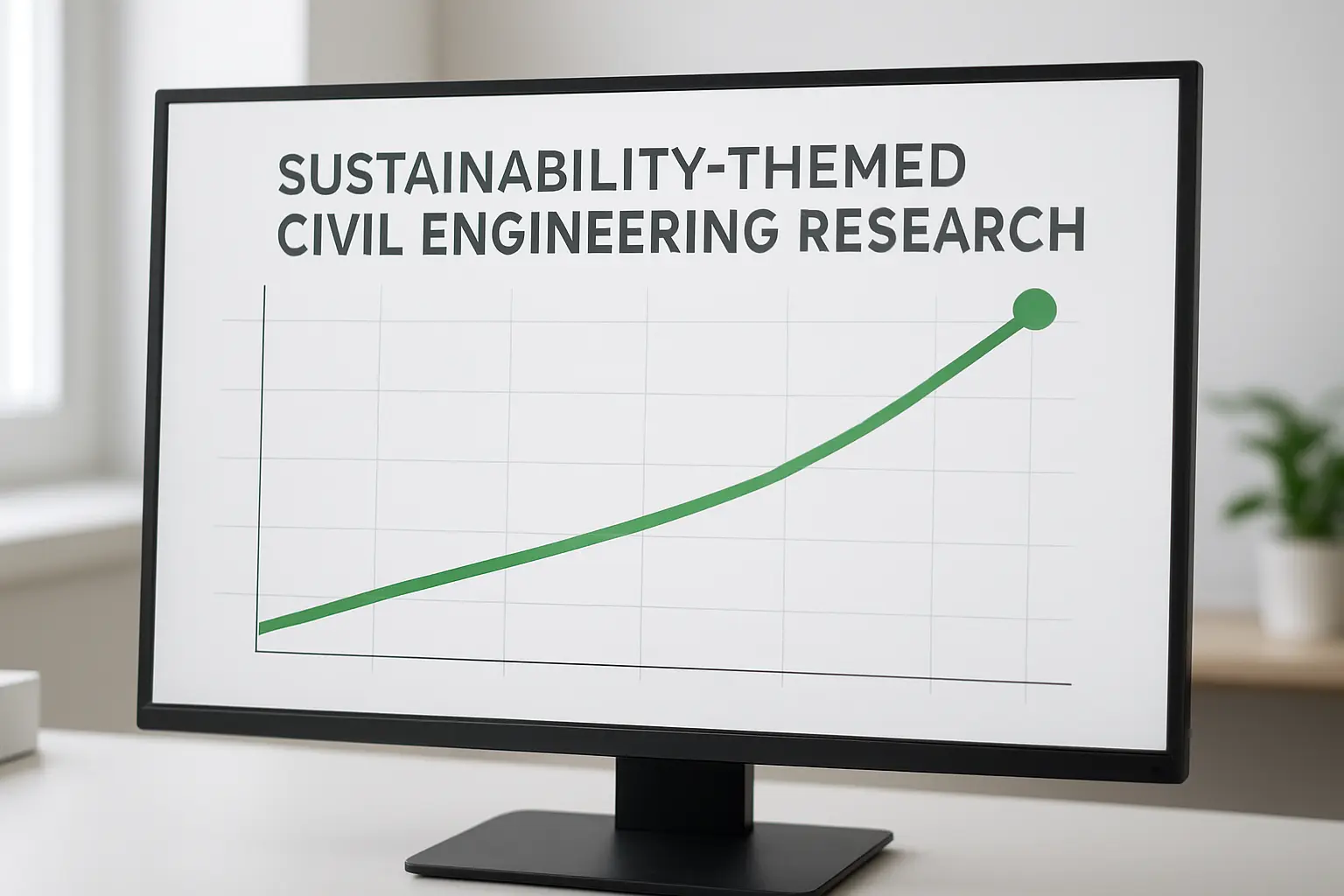
The share of civil engineering doctoral theses carrying a sustainability keyword in their metadata has more than tripled in six years — from 2.9% of the field’s output in 2018 to 9.9% in 2024, measured against the OpenAIRE Graph, the same keyless, queryable index used elsewhere on this site for doctoral-output counts. An equivalent AI-keyword count exists too, but at a base too small to trend honestly, and this piece says so rather than dressing up two data points as a pattern.
The sustainability share, measured directly
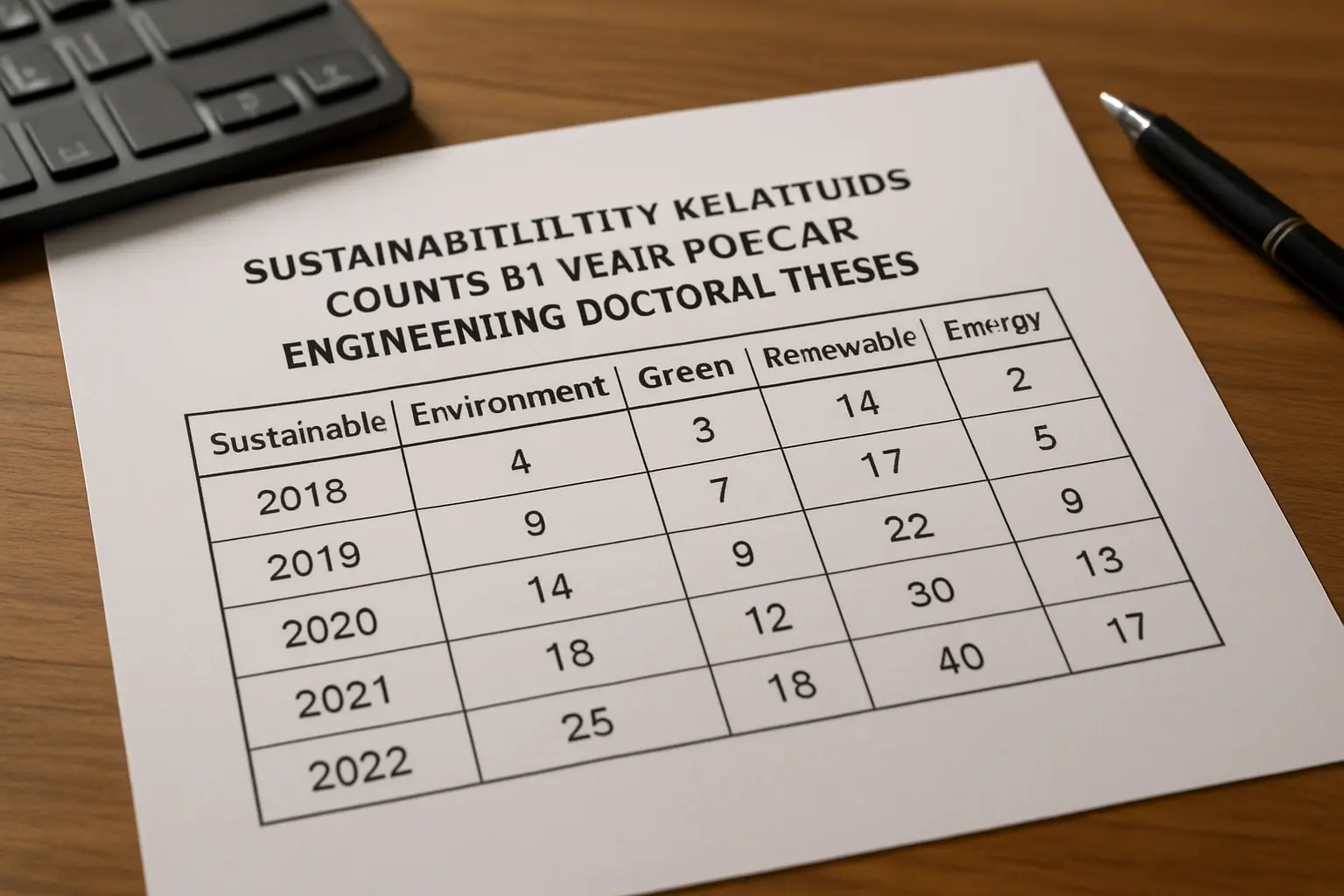
Querying the OpenAIRE Graph — a keyless, unauthenticated aggregation of research-output metadata already used on this site to count doctoral theses globally — for records typed as a doctoral thesis, carrying the keywords “civil engineering” and “sustainability” together, and accepted within each calendar year, against the same query without the sustainability term as a denominator, produces a clear and consistent upward share:
| Year | Sustainability-keyword civil engineering doctoral theses | All civil engineering doctoral theses | Share |
|---|---|---|---|
| 2018 | 4 | 138 | 2.9% |
| 2020 | 9 | 291 | 3.1% |
| 2022 | 8 | 170 | 4.7% |
| 2023 | 11 | 166 | 6.6% |
| 2024 | 16 | 161 | 9.9% |
Queried directly against api.openaire.eu/search/publications on 2026-09-18, filtering instancetype=Doctoral thesis and fromDateAccepted/toDateAccepted to each calendar year, with size=0 returning only the total-match count rather than full records — the same lightweight, single-parameter query method already used elsewhere on this site to count doctoral output by country, run here instead as a within-field keyword share rather than a cross-country comparison. The 2020 total (291) is a genuine outlier in the denominator series and should be read as a coverage or indexing artefact of that particular year’s aggregation, not as a real doubling of civil engineering doctoral output — which is exactly why the share column, not the raw counts alone, is the number worth reading.
One specific sub-topic, measured the same way
Narrowing the sustainability keyword to a specific method — “life cycle assessment,” a defined technique for quantifying a material or structure’s environmental impact across its full service life — returns 0 civil engineering doctoral theses in 2018 and 4 in 2024 against the same query structure. Like the AI-keyword figure below, this is too small a base to report as a percentage or a growth rate, but it is directionally consistent with the broader sustainability-keyword share: a specific, named methodology that barely registered in the indexed metadata six years ago now appears with some regularity. Where the broader sustainability share (Table above) is robust enough to plan around, a sub-method count this small is better read as an early-warning signal — worth re-querying next year to see whether it is still growing — than as a number to build a staffing decision on today.
What this means for a civil engineering faculty’s review capacity
A faculty whose thesis-proposal review process, examiner pool and supervision assignments were built around a stable mix of structural, geotechnical, hydraulic and transportation-engineering topics is now seeing roughly one in ten proposals carrying an explicit sustainability framing — life-cycle carbon assessment, circular-economy materials, climate-resilient infrastructure design — a framing that may need a different reviewer expertise, a different set of journals and standards referenced, and in some cases a different data source (environmental impact databases rather than structural-testing datasets) than the department’s traditional examiner pool was built around. This is a capacity-planning signal, not a judgement on any individual thesis: a review panel with zero members whose own research touches sustainability-adjacent methods will increasingly be asked to examine work outside its collective expertise as the share keeps climbing.
Sizing the scale of this against the faculty’s own cohort matters more than the headline percentage alone. A civil engineering doctoral programme admitting 40 candidates a year, at a 9.9% sustainability-keyword share, is looking at roughly four proposals a year with this framing today, against fewer than one a year in 2018 — a small absolute number that is nonetheless a real and rising claim on a specific kind of examiner expertise the panel may not currently hold in depth. A larger programme admitting 150 candidates a year is looking at closer to fifteen, which is a meaningfully different staffing question than four. Running the faculty’s own admissions numbers against the index-wide share, rather than reasoning from the percentage alone, is what turns this data point into an actual planning input.
The examiner-pool question this raises is a narrower, discipline-specific instance of the general expertise-matching principle already argued for a different field in how a clinical thesis viva should be structured: a panel assembled for one competency profile cannot credibly assess work that genuinely spans a second one, whether the second competency is applied clinical reasoning or environmental-impact methodology. The fix in both cases is the same in shape even though the specific expertise gap differs — name the gap explicitly, and add or reassign examiner capacity to cover it, rather than assuming a generalist panel can absorb an increasingly specialised share of submissions.
Why the AI-keyword count does not support the same trend claim

The same query structure, run for “civil engineering” and “artificial intelligence” together, returns 0 doctoral theses in 2018 and 2 in 2024 — a real increase from a real zero, but at a base far too small to support a percentage, a growth rate, or any claim stronger than “AI-keyword civil engineering doctoral theses now exist in the index where they previously did not.” Reporting this as a “surge” alongside the sustainability figures, the way the trend-lens framing might invite, would misrepresent what two data points can actually support. The honest reading is narrower: AI-adjacent civil engineering doctoral research is a real, recent, still-small phenomenon in the indexed metadata, and a faculty tracking this should expect the count to be a leading indicator worth re-measuring annually, not yet a basis for capacity decisions the way the sustainability share already is.
How this relates to the AI-use policy question already covered on this site
Where an AI-keyword civil engineering thesis does emerge, the institutional questions it raises — how AI use in the research itself should be disclosed, distinct from AI use in drafting the write-up — are the same category of question already addressed generally in how AI rules differ for a doctoral thesis compared with coursework. This piece is about counting how often the topic itself now involves AI as a research method or object, not about drafting-process disclosure, which is a separate and already-covered question.
Sizing this against the wider doctoral-output picture
The 138-to-291 range in the raw civil engineering denominator sits inside the same measurement caution already documented in how many doctoral theses are produced each year: an open, aggregated index like OpenAIRE is the best keyless global count available, but it is a coverage snapshot at the moment of query, not a definitive national register, and recent years in particular are liable to be undercounted as indexing catches up — meaning the true current sustainability share for 2024 and 2025 is more likely to be understated by this method than overstated. A faculty wanting an exact figure for its own institution should run the same query scoped to its own output, or check its own repository’s subject-tagging directly, rather than assuming this cross-institutional aggregate applies precisely to its own cohort.
Common misreadings of this kind of trend data
Three misreadings recur when a research office picks up a keyword-trend figure like this one. First, treating the raw count rather than the share as the headline number — 16 sustainability-keyword theses in 2024 sounds unremarkable in isolation, but the share tripling against a roughly stable denominator is the actual finding. Second, assuming the trend generalises evenly across every civil engineering sub-specialism, when it plausibly concentrates in materials and structures (where life-cycle assessment sits) more than in, say, surveying or construction management, a distinction this keyword-level query cannot resolve without a further, more targeted search. Third, treating a small early-signal count like the AI-keyword or life-cycle-assessment figures as equivalent in strength to the headline sustainability share, when the honest reading keeps them in separate categories: one robust enough to plan a review panel around, the others worth watching but not yet worth budgeting against.
This kind of field-level trend sits alongside the broader postgraduate-enrolment picture already published in postgraduate enrolment by field of study, which sizes the engineering cohort nationally without breaking out sub-topic trends within it — the two data sources answer different questions and are worth reading together rather than as substitutes for each other.
Where Tesify fits
Tracking a thesis-topic trend is a research-office data question Tesify does not automate — the query method above is free and repeatable with nothing more than a browser or a terminal. Where the Tesify for Institutions platform helps once a sustainability-framed thesis is underway is giving the student a structured drafting workspace that a supervisor from an adjacent specialism can still review effectively — visible section-by-section progress rather than a finished draft arriving cold at the point a reviewer’s own expertise gap is hardest to compensate for. A free departmental pilot lets one cohort test this before any procurement decision.
Frequently asked questions
What counts as a “sustainability keyword” in this data?
Records where OpenAIRE’s indexed metadata (title, abstract or keyword field) matches both “civil engineering” and “sustainability” as search terms, not a formal, controlled subject classification — a keyword-matching method, with the usual false-positive and false-negative risk that carries.
Why does the 2020 total look like an outlier?
291 civil engineering doctoral theses in 2020 sits well above every other year in the series (138 to 170), which is more consistent with a coverage or indexing artefact for that specific aggregation snapshot than a genuine near-doubling of output, and is one reason the share column is used rather than the raw counts alone.
Is the AI-keyword count a real trend?
Not yet, honestly. Two records in 2024 against zero in 2018 shows something real exists now that did not before, but the base is too small to support a percentage or growth-rate claim.
Could the true 2024 sustainability share be even higher than 9.9%?
Plausibly, yes. Recent years are more likely to be undercounted in an aggregated index as indexing catches up, which would mean the reported 9.9% understates rather than overstates the true current share.
Can a faculty run this query for its own institution?
Yes. The OpenAIRE Graph API is free, keyless and unauthenticated; scoping the same query to an institution-specific field (where the metadata supports it) or cross-checking against the institution’s own repository tagging gives a more precise local figure than this cross-institutional aggregate.
Does this affect how many examiners a sustainability-framed thesis needs?
It is a capacity-planning signal rather than a rule: a rising share of sustainability-framed proposals is worth checking against whether the current examiner pool has matching expertise, before the gap becomes a scheduling problem.
How often should a faculty re-run this query?
Annually is reasonable given the small underlying numbers — querying more frequently is unlikely to show a meaningfully different picture, and querying less often risks missing the point at which a small, early-signal count (life-cycle assessment, AI-keyword) crosses into a base large enough to trend confidently.
Does a rising sustainability-keyword share mean civil engineering as a whole is growing?
No. The share measures composition within the field, not overall field growth — the denominator (all civil engineering doctoral theses) moved within a comparatively narrow band across the same years, aside from the 2020 outlier, while the sustainability-keyword slice specifically grew.