
It should combine a conventional content viva with a structured, case-based component that tests clinical reasoning the way an OSCE station does — not replace the thesis defence with a clinical exam, but add a rubric element that scores reasoning under a realistic case scenario separately from the written thesis itself. A panel with only academic-methodology expertise cannot assess that dimension credibly.
What makes a medical thesis viva different from a standard thesis defence?
A standard thesis viva tests whether the candidate understands their own research: the design, the analysis, the limitations, how the findings relate to the literature. A medical or clinical thesis frequently makes an additional kind of claim — that a finding should change, inform or caution against a specific clinical practice — and a content-only viva has no structured way to test whether the candidate can actually apply that claim to a realistic clinical scenario, as opposed to simply defending the written argument. This is the gap an OSCE-adjacent component is built to close: not testing hands-on clinical skill, which is a separate competency assessed elsewhere in medical training, but testing whether the candidate can reason through a case where their own thesis findings are actually relevant, under the same time-pressured, structured-questioning format used in an OSCE station.
Who should sit on a clinical thesis examination panel?
At minimum, one methodological examiner (assessing research design, statistical or qualitative rigour, and how the findings are reported) and one clinical examiner active in the relevant specialty (assessing whether the clinical reasoning and practice implications are sound). A panel of only methodologists can wave through a thesis with a confidently stated but clinically naive practice recommendation; a panel of only clinicians can wave through a thesis with a genuine methodological flaw because the clinical conclusion sounds right. Where the thesis touches a specific clinical guideline or protocol, a third examiner familiar with that specific area of practice strengthens the panel further, though two examiners covering both dimensions is the practical minimum most institutions can staff.
What does an “OSCE-adjacent” component actually look like?
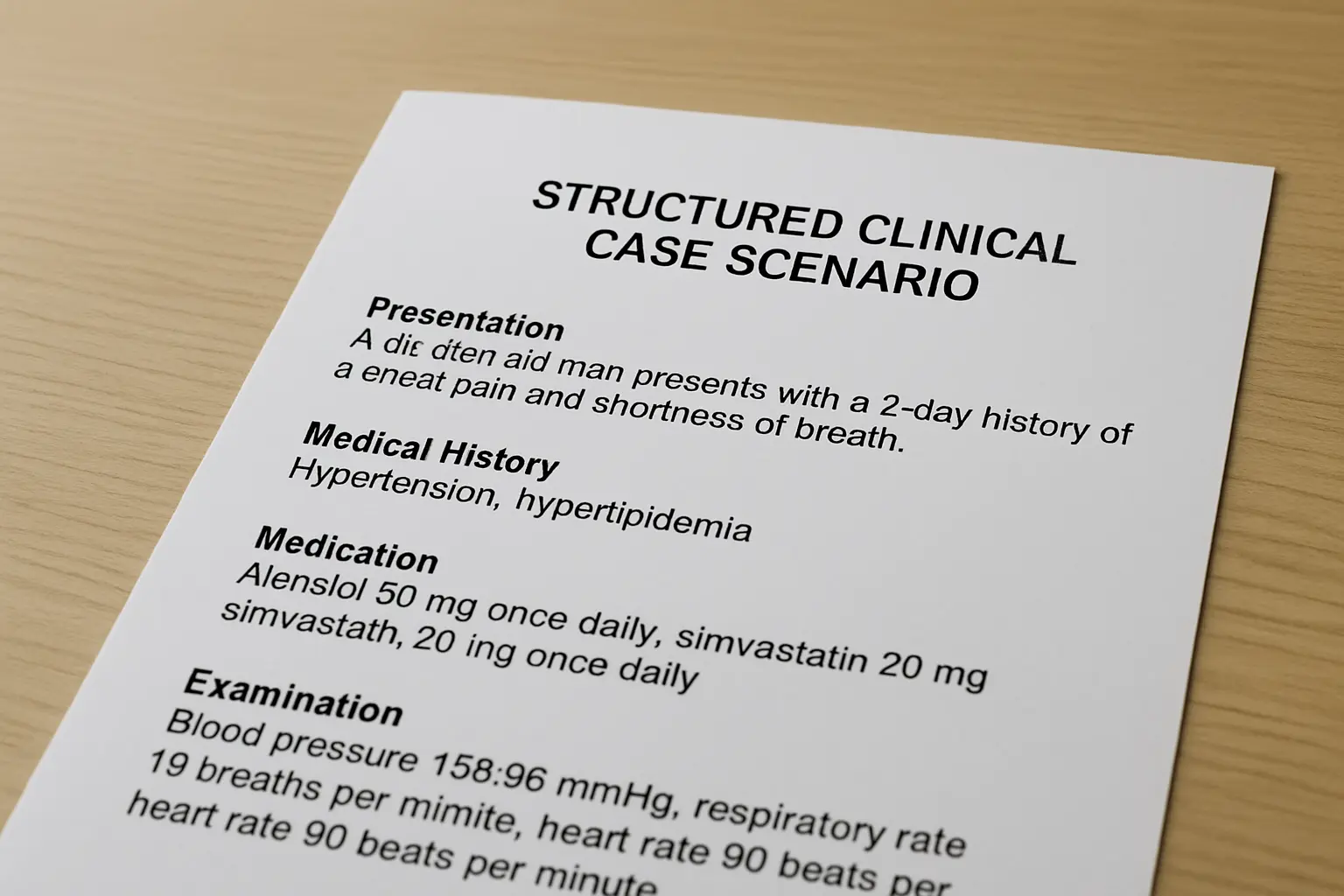
A short, structured station — typically 10 to 15 minutes, run either as part of the same viva session or immediately before it — presents the candidate with a realistic case vignette that intersects with their thesis topic and asks them to reason through it against a scoring rubric the examiners have agreed in advance. The point is not clinical performance (there is no patient, no procedure) but applied clinical reasoning: does the candidate correctly identify where their own findings are relevant to the case, where they are not, and what the genuine limits of applying their research to an individual patient are. A candidate who overstates the generalisability of their own findings when presented with a case outside their study’s population is showing exactly the reasoning gap this component is designed to surface, and a content-only viva rarely catches it because the written thesis’s own limitations section already states the caveat in the abstract, without testing whether the candidate can apply it under pressure.
A worked example: where the gap actually shows up
Consider a thesis studying an intervention’s effect in a hospital-based adult population aged 45 to 70. The written thesis correctly states, in its limitations section, that the findings should not be assumed to generalise to paediatric or elderly patients. At a content-only viva, the candidate can recite that limitation confidently, because it is written down and rehearsed. At the case station, the candidate is presented with an 82-year-old patient whose presentation superficially resembles the study population and asked how the thesis findings should inform management. A candidate who has genuinely internalised the limitation reasons through why the finding does not straightforwardly apply and what would need to be true for it to be relevant; a candidate who has only memorised the limitations paragraph tends to apply the finding anyway, under the pressure of a live case, because reciting a caveat and actually reasoning from it are different skills. This is precisely the gap a content-only viva cannot see, because it never asks the candidate to apply the finding to anything — only to state that a limitation exists.
Common failure modes in running this component
Three failures recur where institutions add a case station without thinking through the design. First, making the case too close to the thesis’s own worked example, so the candidate is effectively re-reciting content rather than reasoning through something novel — the case should intersect with the thesis topic without being a restatement of it. Second, scoring the case station against the same rubric as the academic viva, which collapses the very distinction the component exists to draw between methodological competence and clinical reasoning. Third, running the case station with only the methodological examiner present, which defeats the purpose entirely — the clinical examiner’s judgement is what the station is actually testing against, and their absence turns a clinical-reasoning check into an academic one wearing a different format.
Should this replace the ethics-and-governance questions already covered?
No — it is a different question at a different stage. The tiered ethics-committee model already set out in how a medical school should scale ethics committee review for a thesis cohort governs whether a project was approved to run at all, assessed before data collection starts. The viva structure here governs how the finished thesis is examined, months or years later, and tests a completely different competency — applied clinical reasoning under the candidate’s own findings, not research-governance compliance. A student can pass ethics review cleanly and still have a viva-stage gap in translating their findings to practice; the two checks are not substitutes for each other.
How should the rubric separate academic and clinical scoring?
As two distinct scored dimensions rather than one blended mark. The academic dimension scores the standard viva criteria: research question, method, analysis, contribution to the literature, and the candidate’s ability to defend their own methodological choices. The clinical-reasoning dimension, scored separately against the OSCE-adjacent case station, assesses whether the candidate can correctly apply, and correctly limit the application of, their own findings to a realistic case. Keeping the two scores separate rather than folding the case-station performance into one overall viva mark lets an examination board see specifically whether a weak overall result reflects a methodological problem, a clinical-reasoning problem, or both — each of which points to a different kind of feedback and, if the thesis needs revision, a different kind of correction. This is the same underlying calibration logic already set out generally in how to get consistent marking on extended written work: criteria specific enough that two examiners would score the same performance identically, agreed before the viva rather than improvised in the room. A rubric drafted the morning of the viva, without the clinical and methodological examiners having agreed the scoring dimensions in advance, tends to blur back into one impressionistic overall mark regardless of how the process was designed on paper.
How does this differ from the data-science or AI thesis viva model already covered?
The panel-composition logic is structurally similar — both models argue that a single-discipline panel cannot assess a thesis whose claims span two different competencies — but the second competency being tested is different. How a data science or AI thesis viva panel should be structured adds a code-review component because the thesis’s research object is itself a model whose behaviour needs to be independently verified. Here, the research object is a conventional clinical study; what needs independent verification is not code but the candidate’s ability to translate a statistical or qualitative finding into a defensible clinical judgement under realistic conditions. Both are examples of the same underlying principle — a single-discipline panel cannot assess a thesis whose central claim spans two disciplines — applied to two different fields with two different second competencies.
Where Tesify fits
Structuring and running the viva itself is an assessment decision that stays entirely with the examination board and the clinical and methodological examiners — Tesify has no role in that judgement. Where the Tesify for Institutions platform helps is upstream, in how the thesis itself states its own limits: a supervisor-visible workspace makes it easier to check, before submission, that the limitations and clinical-implications sections of a medical thesis are stated precisely enough that a candidate is not caught out at the case-station stage defending a generalisation the written thesis never actually claimed. A free departmental pilot lets one cohort test this against your own examination board’s current viva structure before any procurement decision.
Frequently asked questions
Does every medical thesis need an OSCE-adjacent viva component?
It is most useful where the thesis makes or implies a clinical-practice recommendation. A purely descriptive or epidemiological thesis with no direct practice claim may not need the case-station component, though a standard clinical examiner on the panel is still worth including.
How long should the case-based station take?
Typically 10 to 15 minutes, either run as part of the same viva session or immediately before it, kept short enough to test reasoning under a realistic case without turning the viva into a full clinical assessment.
Does the case station test hands-on clinical skill?
No. It tests applied clinical reasoning — whether the candidate can correctly apply and correctly limit their own findings against a realistic case — not a physical or procedural skill, which is assessed separately elsewhere in medical training.
Should the clinical-reasoning score be blended into the overall viva mark?
Scoring it separately from the academic-methodology dimension is more useful, because it lets an examination board see specifically which competency was weak if the overall result is borderline.
How many examiners does this require?
At minimum one methodological examiner and one active clinical examiner in the relevant specialty. A third examiner familiar with a specific guideline or protocol the thesis touches strengthens the panel further where staffing allows.
Is this the same as the ethics-committee tiering already covered on this site?
No. Ethics-committee review governs whether a project was approved to run, assessed before data collection. This governs how the finished thesis is examined at viva, testing a different competency at a different stage.
How is this different from the data-science or AI thesis viva model?
Both add a second examiner competency because the thesis spans two disciplines, but the second competency differs: code-review and model verification for a data-science thesis, applied clinical reasoning for a medical thesis.
What is the most common failure this component catches?
A candidate overstating the generalisability of their own findings when presented with a case outside their study’s population — a reasoning gap the written thesis’s limitations section often states correctly in the abstract but that a content-only viva does not test under realistic pressure.
Who should design the case scenario used in the station?
The clinical examiner, in most institutions, since it needs to be realistic enough to test genuine reasoning and specific enough to intersect meaningfully with the thesis topic without simply restating the thesis’s own worked example.
Should the case station happen before or after the main content viva?
Either can work; what matters more is that the two components are scored separately and that the same panel sits for both, so the clinical examiner’s read on the case station can inform, without dominating, the overall discussion.