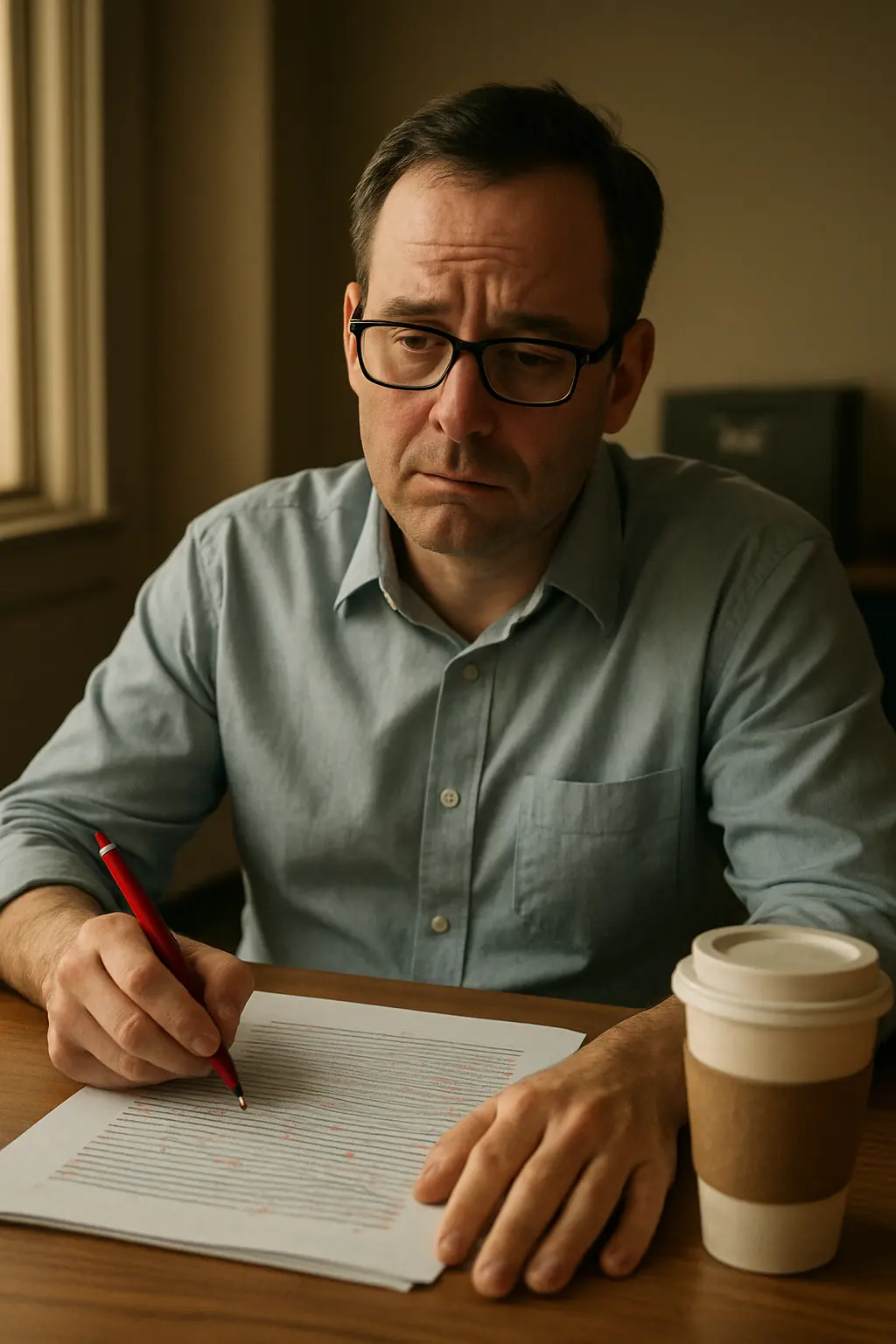
A supervisor opens the chapter that arrived on Friday. Twenty minutes later they have written eleven comments. Nine are about the reference list, the heading levels and a table that lost its numbering. Two are about the argument.
Both parties know which two mattered. Both also know that the nine had to be written, because the chapter cannot go to a committee in that state and nobody else was going to catch them. That exchange, repeated across a graduate school for three years per candidate, is the largest unmanaged cost in doctoral education — and it is not a cost that appears in any budget line.
The constraint is attention, and it cannot be bought quickly
Graduate schools do not run out of money before they run out of experienced supervisors’ attention. Recruitment does not fix it on any useful timescale; a new appointment cannot supervise a candidate who is eighteen months in. Workload models redistribute the problem without reducing it.
So the only intervention available at the speed institutions actually need is changing what supervision time is spent on. That is a smaller, more tractable claim than “improving supervision”, and it is measurable.
It also compounds in a direction most workload models do not capture. A revision cycle spent largely on presentation still consumes a full cycle of calendar time — the candidate waits for the return, acts on it, and resubmits, typically over two to four weeks. Two such cycles per chapter across a six-chapter thesis is a term of elapsed time that produced no advance in the argument. Time-to-completion pressure is usually addressed through milestones and monitoring; a meaningful share of it is simply this, and milestones do not touch it.
Measure the split before you decide it is not a problem
You do not need a research project. You need one term and a small group of willing supervisors.
- Ask six supervisors to tag every comment they write on a returned chapter as surface — reference format, heading structure, numbering, cross-references, layout — or substance — argument, evidence, method, interpretation.
- Count, do not time. Counting comments takes seconds and produces a stable ratio; asking academics to time themselves produces attrition by week three.
- Record the chapter stage. First draft, revision, pre-submission. The ratio differs sharply across them and the difference is the finding.
- Report three numbers: comments per chapter, surface share, and the number of chapters where surface comments outnumbered substantive ones.
That third number is the one that moves a committee, because it converts an abstraction into a count of specific chapters where an experienced researcher’s time was spent on work that did not need them. A local baseline like this is worth more to your decision than any sector average, for the reasons set out in why local measurement beats national figures.
Two design cautions, because this instrument is easy to break. Do not ask supervisors to estimate percentages from memory — recall on this question is unreliable in both directions, and the estimate will be contested precisely because it is an estimate. And do not announce a target before the baseline is taken; a measurement introduced alongside an expected direction of travel stops being a measurement.
Why the surface defects keep recurring
Because a thesis is longer than anyone can hold in their head, and it is written across years in a tool with no memory of its own conventions.
Three mechanisms produce almost all of it:
- Reference drift. Entries added at different times in different states — some from a manager, some pasted, some typed — and never reconciled until the end, at which point reconciliation is a two-day job.
- Structural drift. A chapter moved, a section promoted, heading levels no longer consistent between chapters written eighteen months apart.
- Assembly damage. Six files becoming one document, at which point numbering, cross-references and figure captions break simultaneously and silently.
None of these is a competence failure and none is fixed by telling students to be careful. They are properties of writing a very long structured document in an environment that does not enforce structure. Change the environment and the defects stop arriving.
What changes when the structure holds
The claim worth making is narrow and testable: if chapter scaffolding, heading hierarchy and referencing stay consistent as the document grows, the surface comments have nothing to be about.
What that produces for a graduate school:
| Before | After |
|---|---|
| Supervisor is the first line of quality control on presentation | Presentation is handled where the writing happens |
| Structural problems surface at assembly, weeks before deposit | Structure is continuous, so assembly is not an event |
| Review meetings open with a list of corrections | Review meetings open with the argument |
| Progress is visible only when a chapter arrives | Progress is visible while it happens |
| The candidate learns that feedback is mostly about form | The candidate learns what a supervisor is actually for |
The last row is the one that compounds. A candidate whose first two years of feedback were dominated by formatting has been trained to submit for correction rather than for critique, and that habit persists into the viva.
Where Tesify for Institutions fits
Feature by feature, and only where it removes work from a person:
- Chapter scaffolding. The thesis structure is held by the platform rather than by the candidate’s memory, so heading hierarchy stays consistent across chapters written years apart. Removes: structural comments and assembly damage.
- Referencing held consistent as the document grows. Entries stay in one state, so the end-of-process reconciliation does not exist. Removes: the largest single category of surface comment.
- Visible progress at chapter level. A supervisor can see where a candidate is without requesting a draft. Removes: the check-in email and the surprise.
- The candidate’s contribution stays legible as their own. Which is what your integrity policy requires and what a viva examines. Removes: the ambiguity that makes AI-era supervision uncomfortable.
What it does not do is screen submissions. Support and screening are different purchases, and an institution with a functioning similarity contract should not be asked to abandon it — the distinction is set out in our ranking of writing platforms for universities and in what changed in the integrity platform market this year.
The next step is a pilot, not a purchase order
A free departmental pilot is the right size of commitment here, for a procedural reason as much as a financial one: a pilot clears governance in a way a purchase does not, and it produces the evidence your business case will need anyway.
Run it in one department, for one term, with the comment-tagging baseline above taken in the term before. Two numbers at the end — surface share before, surface share after — settle the question in a form no vendor claim can. The design, the criteria and the artefacts each step produces are in our guide to running a departmental pilot of an AI writing tool, and the data protection review can run in parallel using our DPIA sequence rather than after it.
Request an institutional evaluation and we will scope a departmental pilot against your own supervision load.
Frequently asked questions
How much supervision time actually goes on formatting?
Unknown until you measure it locally, which takes one term of comment tagging. Institutions that measure it are consistently surprised by the surface share on first drafts.
Isn’t this the student’s responsibility?
Yes, which is why the fix belongs in the student’s writing environment rather than in the supervisor’s inbox. Responsibility and where the work gets caught are different questions.
Would a style guide solve it?
Most institutions already have one. The defects arise from documents drifting over years, not from students being unaware of the guide.
Does this replace the writing centre?
No. It reduces the volume of routine presentation work reaching both the writing centre and supervisors, which is what makes specialist support available for the cases that need a person.
Is this a detection tool?
No. It changes how work is produced rather than examining it after submission. The two are complements.
What about our academic integrity policy?
Keeping a candidate’s contribution legible as their own is what the policy requires, and structured drafting makes that easier to demonstrate rather than harder.
Does this affect time to completion?
Plausibly, through elapsed time rather than effort: a revision cycle spent on presentation still costs the weeks a cycle takes. Treat that as a hypothesis to test in your pilot rather than as a claim.
How long does a pilot take?
One term, in one department, with a baseline taken the term before.
What does the pilot cost?
The departmental pilot is free. The cost is coordination time, which is also what makes it clear governance quickly.
What evidence will we have at the end?
Surface share before and after, comments per chapter, and supervisor and candidate feedback against criteria agreed in advance.
Who should own the pilot?
An academic owner — usually a graduate school director or associate dean — with IT and the DPO supporting.
What if our supervisors are sceptical?
Start with the measurement rather than the tool. Sceptical supervisors are usually willing to count comments, and the count makes the argument on its own.
Can we run this alongside our existing contracts?
Yes. It is designed to sit alongside a screening contract rather than to displace one.