
TU Delft’s own Doctoral Regulations require two mechanisms most non-Dutch policy teams have never had to design: a mandatory library plagiarism scan the promotor must sign off on before approving a draft dissertation, and a set of “propositions” — as a guideline no more than ten — submitted alongside the thesis, at least six of which must not pertain to the dissertation’s own subject. Neither appears in the MIT or Cambridge regulations already covered on this site — each institution’s published rules are genuinely different documents, not variations on one template.
What TU Delft’s Doctoral Regulations actually cover
TU Delft publishes its Doctoral Regulations and Implementation Decree as a single governing document, most recently the 2023 edition, alongside a set of faculty-level forms and manuals hosted on the university’s own filelist.tudelft.nl document server and referenced from graduate-school pages such as the Aerospace Engineering faculty’s “Forms, Regulations & Documents” page. TU Delft describes the Doctoral Regulations as containing “the core provisions concerning the rights and obligations of the persons and bodies involved in their implementation: doctoral candidates, promotors, doctoral committees and the Board for Doctorates”, and says they “guarantee the quality of the Doctoral programme, the Doctoral Education programme, the dissertation, the defence and thus the awarding of the PhD degree” — language that puts the dissertation’s format requirements inside a wider governance document rather than a standalone style guide, which is a different structure from MIT’s dedicated thesis-specifications page or Cambridge’s standalone word-limit page.
The propositions requirement
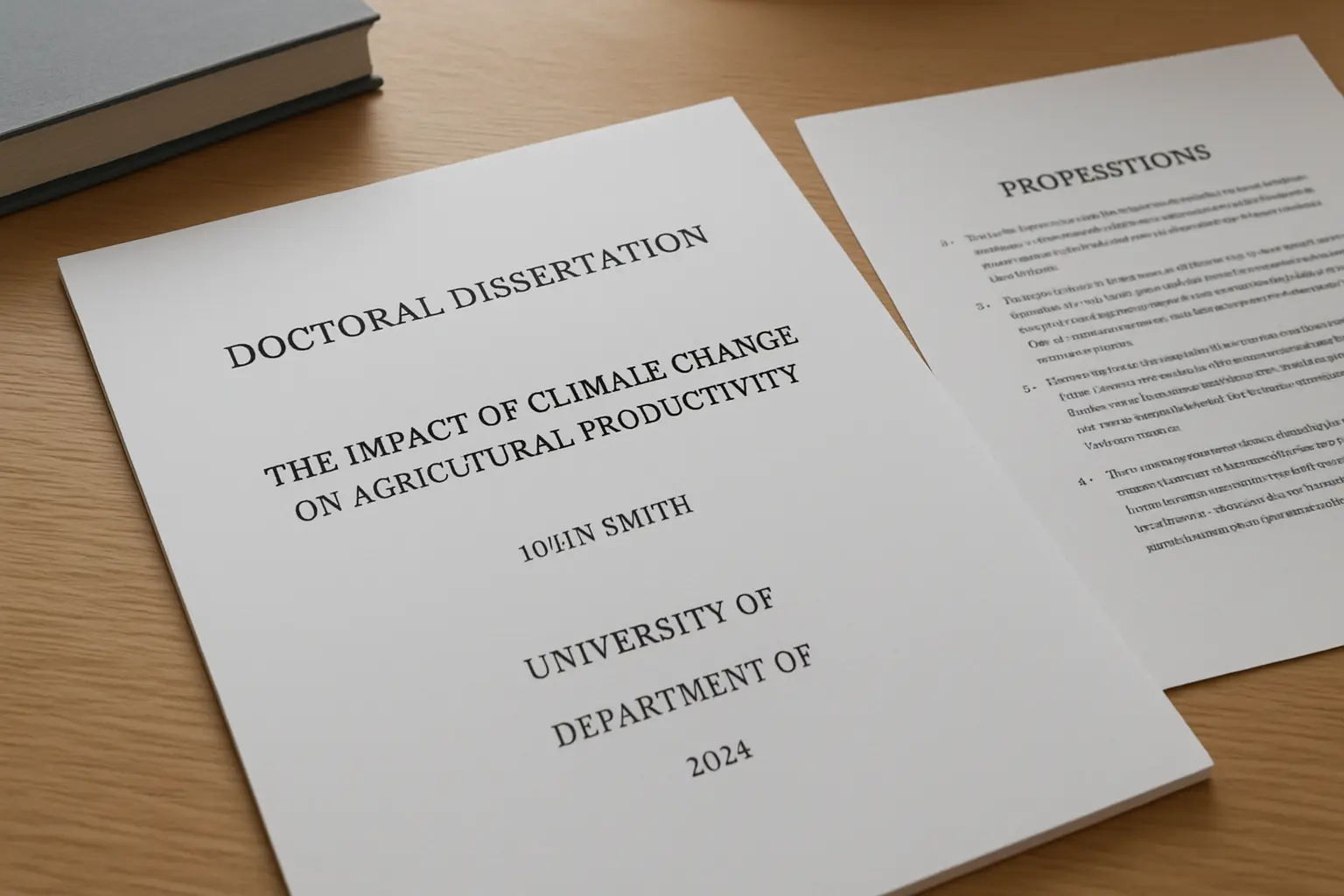
A TU Delft doctoral candidate adds propositions to the dissertation — as a guideline, no more than ten, approved by the promotor — and at least six of them must not pertain to the subject of the dissertation. Propositions are written in Dutch or English, with English the preferred language. This is a genuinely distinctive mechanism in the Dutch and Belgian doctoral tradition — a set of defensible, arguable statements the candidate is separately examined on at the public defence, deliberately including statements outside the thesis’s own subject area to test the candidate’s broader scholarly judgement rather than only their command of their own narrow topic. Neither MIT’s nor Cambridge’s published requirements, as read for the earlier benchmark on this site, include anything equivalent: both institutions examine the dissertation itself and, for Cambridge, a viva on the thesis, but neither publishes a separate propositions requirement with its own topic-relevance rule. A policy team benchmarking against Dutch institutions should treat propositions as a distinct governance item, not assume it maps onto a familiar “abstract” or “summary” requirement.
Regulations are university-wide; the forms are published per faculty
One structural detail worth flagging for a policy team trying to replicate this benchmark: the Doctoral Regulations and Implementation Decree itself is a single, university-wide document, but the practical forms, manuals and “Forms, Regulations & Documents” landing pages that link to it are published separately by each TU Delft faculty — the page opened for this piece belongs to the Aerospace Engineering (AE) Graduate School specifically, and its own contact details (a faculty service desk email and phone number) are AE-specific, not university-wide. A different TU Delft faculty’s equivalent page would carry the same underlying regulations but its own local contact point and possibly its own supplementary local guidance. A policy team citing TU Delft’s requirements should be precise about whether a given practical detail comes from the university-wide regulations document or from one faculty’s own implementation page, since only the former is binding across the whole university.
The mandatory pre-approval plagiarism scan
TU Delft’s own published requirement states that the doctoral dissertation must be free of plagiarism, that the promotor is responsible for ensuring this and must make a statement to that effect upon approving the draft doctoral dissertation, and that the promotor and doctoral candidate must submit a digital version of the draft dissertation for a plagiarism scan using software the TU Delft Library makes available for that purpose. This places the plagiarism check at a specific, named point in the workflow — before promotor approval of the draft, not as a separate integrity process run after submission or only in response to a concern — and it names a specific institutional actor (the Library) as the operator of the scanning software, rather than leaving the check to whichever tool an individual supervisor happens to use. Neither the MIT nor Cambridge pages already covered on this site state an equivalent library-operated, promotor-facing scan requirement as explicitly.
Title page and submission format
The regulations require a two-sided title page, with the exact formatting specified in separate manuals — TU Delft publishes at least two versions, one for a standard dissertation and one for dual-degree dissertations, each also covering the accompanying propositions page. The propositions go on a separate sheet added to the dissertation, and the candidate must make a digital version of the dissertation available to the University Library for the TU Delft repository, as a PDF file or in another agreed format. Faculty-level pages point candidates to the “Requirements and format of doctoral dissertation” section of the Doctoral Regulations document itself, stated to begin around page 46 of that document, for the full formatting detail beyond what the manuals cover.
What this page does not state
The pages opened for this piece — TU Delft’s Doctoral Regulations summary, the AE faculty’s Forms, Regulations & Documents page, and the search results locating the Doctoral Regulations and Implementation Decree 2023 PDF and the PhD Guidebook — do not state a specific word-count or page-count limit for the dissertation itself, comparable to Cambridge’s published 80,000-word PhD cap, nor do they state an AI-use or generative-AI disclosure policy for the dissertation. Both are plausible topics for a separate TU Delft policy page not opened for this piece, and neither should be assumed either way without opening the specific source. This is the same discipline already applied to the MIT and Cambridge benchmark: state what was read, and say so explicitly where a page is silent rather than filling the gap with an assumption.
How TU Delft compares with MIT and Cambridge
The three institutions’ published regulations, read directly rather than inferred from reputation, turn out to differ on structure as much as on content. MIT and Cambridge’s own thesis format regulations each publish dedicated pages addressing format, length and submission separately from the institution’s general doctoral-governance rulebook; TU Delft folds the same material into a single Doctoral Regulations and Implementation Decree document covering the whole doctoral process, with format detail appearing well into that document rather than on its own page. The propositions requirement and the library-operated pre-approval plagiarism scan are TU Delft-specific mechanisms with no direct equivalent stated on the MIT or Cambridge pages already read for this site. A policy team building a comparative regulation table across these three institutions should treat “does the institution publish a standalone format page or fold format into a general regulations document” as its own comparison row, not an incidental detail.
| Item | TU Delft | MIT / Cambridge (as previously benchmarked) |
|---|---|---|
| Document structure | Single Doctoral Regulations and Implementation Decree covering the whole doctoral process | Dedicated, standalone thesis-specifications / word-limit pages |
| Propositions requirement | Guideline of no more than 10, at least 6 not pertaining to the subject, English (preferred) or Dutch | Not stated on the pages read |
| Plagiarism scan | Mandatory, library-operated, before promotor approval of the draft | Not stated as explicitly on the pages read |
| Submission format | Two-sided title page per a published manual; digital copy (PDF or agreed format) to the University Library | MIT: PDF/A-1 from accessible source files |
Why this matters for a policy team benchmarking against multiple countries
A graduate school comparing its own regulations against international peers gains little from a single-institution read, because one institution’s idiosyncrasies — TU Delft’s propositions requirement is a strong example — can look like a general doctoral-education norm if that is the only external regulation a policy team has actually opened. Reading TU Delft alongside MIT and Cambridge shows the opposite: three research-intensive institutions with three structurally different approaches to publishing and governing their own dissertation requirements, none of which maps cleanly onto either of the other two. The practical implication for a policy team is to treat each named institution’s regulations as a distinct document to open and read, rather than assuming any single benchmark generalises across a national system, let alone across countries.
This also matters for a graduate school sizing its own doctoral cohort against sector data: the Netherlands is one of the five countries already covered in postgraduate enrolment by field of study, and a policy team working from both that enrolment picture and TU Delft’s own regulation detail has a genuinely dual view — how large the Dutch postgraduate population is by field, and what one specific, research-intensive Dutch institution actually requires of its doctoral candidates procedurally. Neither substitutes for the other: aggregate enrolment data says nothing about a propositions requirement, and one institution’s regulations say nothing about the national picture. The same caution applies to the discipline-level page-and-word conventions already set out in thesis length regulations by discipline — a national or cross-country convention is a different kind of fact from one named institution’s own currently published rule, and a defensible policy comparison keeps the two separate rather than treating a discipline norm as a stand-in for what a specific university’s regulations actually say.
Where Tesify fits
Tesify does not set or interpret institutional regulations — TU Delft’s own Doctoral Regulations remain the authority on what its candidates must submit. Where the Tesify for Institutions platform helps a graduate school is standardising the mechanical parts of compliance once a regulation like TU Delft’s is understood: consistent formatting ahead of a title-page or PDF submission check, and a supervisor-visible workspace that makes a pre-submission compliance review easier to run at cohort scale rather than candidate by candidate. A free departmental pilot lets one graduate school test this against its own current regulation set before any procurement decision.
Frequently asked questions
What are TU Delft’s propositions, in plain terms?
A set of defensible statements added to the dissertation — as a guideline no more than ten — at least six of which must not pertain to the dissertation’s own subject, written in Dutch or English (English preferred), and examined at the public defence.
Who is responsible for the plagiarism scan on a TU Delft PhD dissertation?
The promotor and doctoral candidate together submit the draft for a scan using software the TU Delft Library provides, and the promotor must make a formal statement that the dissertation is free of plagiarism upon approving the draft.
Does TU Delft publish a specific word-count limit for a doctoral dissertation?
Not on the pages opened for this piece. The Doctoral Regulations document’s own “Requirements and format of doctoral dissertation” section, starting around page 46, is the likely source for any such figure and was not opened in full for this article.
What submission format does TU Delft require?
A two-sided title page and a separate propositions sheet, formatted according to a published title-page-and-propositions manual with separate versions for standard and dual-degree dissertations, plus a digital version of the dissertation (PDF or another agreed format) for the University Library.
How does TU Delft’s regulation structure differ from MIT’s or Cambridge’s?
TU Delft folds dissertation format requirements into a single Doctoral Regulations and Implementation Decree covering the whole doctoral process, while MIT and Cambridge each publish dedicated, standalone thesis-specification or word-limit pages.
Does TU Delft state an AI-use or generative-AI disclosure policy for dissertations?
Not on the pages opened for this piece. This should not be read as an absence of any such policy at TU Delft — only that it was not found on the specific pages consulted here.
Is the propositions requirement unique to TU Delft?
It is a recognised feature of the Dutch (and Belgian) doctoral tradition more broadly, not invented by TU Delft specifically, but it was confirmed here only for TU Delft’s own published regulations, not surveyed across other Dutch universities.
Where should a policy team look for the full formatting detail?
The Doctoral Regulations and Implementation Decree document itself, in the section covering dissertation requirements and format, plus the separate title-page-and-propositions manuals TU Delft publishes alongside it.