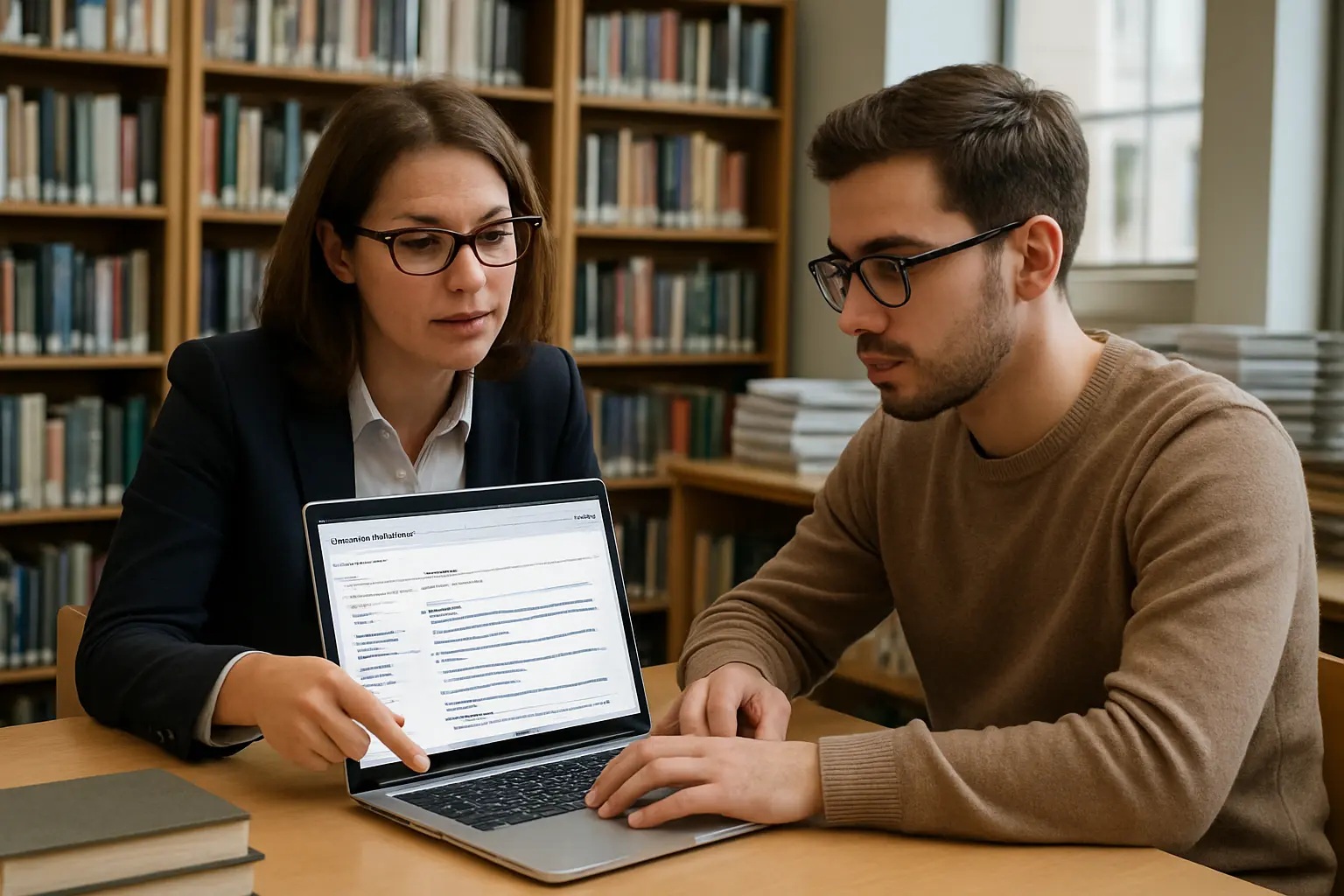
Communication and Journalism programmes ask graduate students to run literature reviews across a genuinely fragmented database landscape — no single index covers the field the way PubMed covers biomedicine or Web of Science covers the physical sciences. A generalist liaison-librarian model, built for one subject guide and a handful of office hours per term, breaks down once a cohort of thesis students needs structured search support at the same time. This is what a graduate school or library director can actually commit to, and where the model breaks first.
Why a general liaison model strains on Communication and Journalism reviews
Most academic libraries assign one liaison librarian to Communication, Media Studies and Journalism as a combined subject area, often alongside two or three other departments. That works for one-off reference questions. It works far less well for a cohort of twenty or thirty thesis students who each need a structured, reproducible search strategy across several databases with different controlled vocabularies and different date coverage — and who mostly arrive in the same eight- to ten-week window each academic year, at the point their proposal is approved and their review chapter is due.
Set against how many theses a faculty actually produces each year — see how many doctoral theses are produced each year for the queryable count — the strain shows up in three places: search-strategy consultations queue past the point where they are still useful for a review the student needs to draft that term; workshop capacity is shared with three or four other subject areas competing for the same teaching slots; and database access itself is uneven, because Communication and Journalism sit at the boundary of several licensing categories — social science, humanities and, increasingly, computational/data-science tools for content analysis.
The databases a Communication or Journalism review actually needs
A defensible review in this field rarely runs on one database. The core set that a search strategy should document, with the licence question a library needs to answer before a cohort can be told to use it:
| Database | Publisher | What it adds | Licence note for a graduate cohort |
|---|---|---|---|
| Communication & Mass Media Complete | EBSCO | The closest thing the field has to a dedicated index — trade and scholarly journals in communication, media, journalism and public relations | Concurrent-user caps are common; a cohort searching in the same week can exhaust a small licence |
| Communication Source | EBSCO | Combines Communication & Mass Media Complete with CommSearch, adding conference proceedings | Often bundled, but check whether your institution has the combined product or the standalone index |
| Web of Science | Clarivate | Citation tracking and journal-impact context for a theoretical-framework chapter | Per-seat pricing; institutions frequently restrict simultaneous sessions |
| Scopus | Elsevier | Broader multidisciplinary coverage, useful where a thesis crosses into psychology, sociology or political communication | Coverage overlaps Web of Science by roughly two-thirds in most fields; students need to be told which one is the primary search and which is the cross-check, not both run as duplicates |
| JSTOR | ITHAKA | Historical journal backfile, strongest for media-history and journalism-history theses | Moving-wall embargo means the most recent three to five years of a journal are usually absent — a student searching only JSTOR will miss current literature |
| ProQuest Communication Collection | ProQuest | Dissertations and theses full text, useful for locating comparable prior work at the same institution or peer institutions | Coverage of grey literature (conference papers, working papers) is uneven outside North America |
None of these databases index everything, and none of them is optional on its own — a review that runs only Communication & Mass Media Complete misses the citation-network view Web of Science or Scopus provides, and a review that runs only Scopus misses the field-specific vocabulary and trade coverage the dedicated communication index carries. The workshop content below exists because that combination is not obvious to a student encountering it for the first time.
What a search-skill workshop should cover, and who should run it
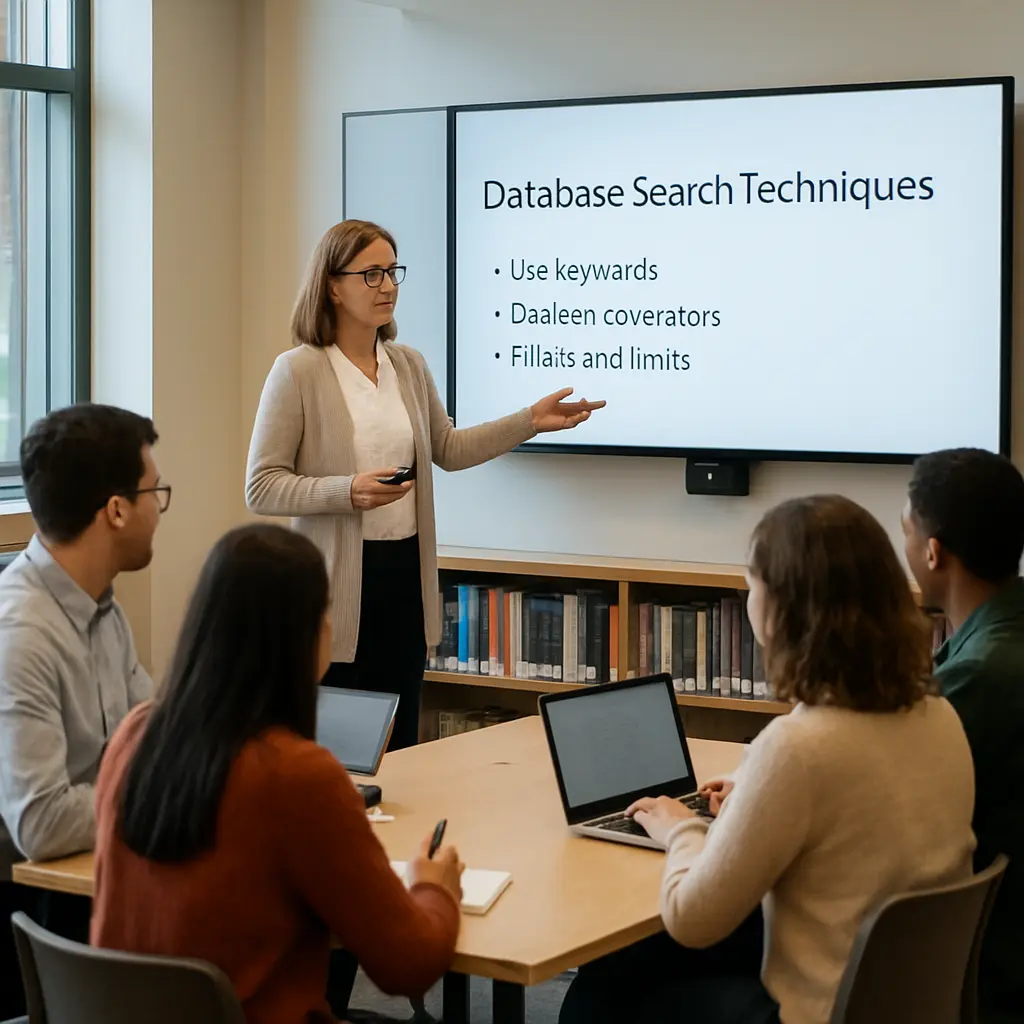
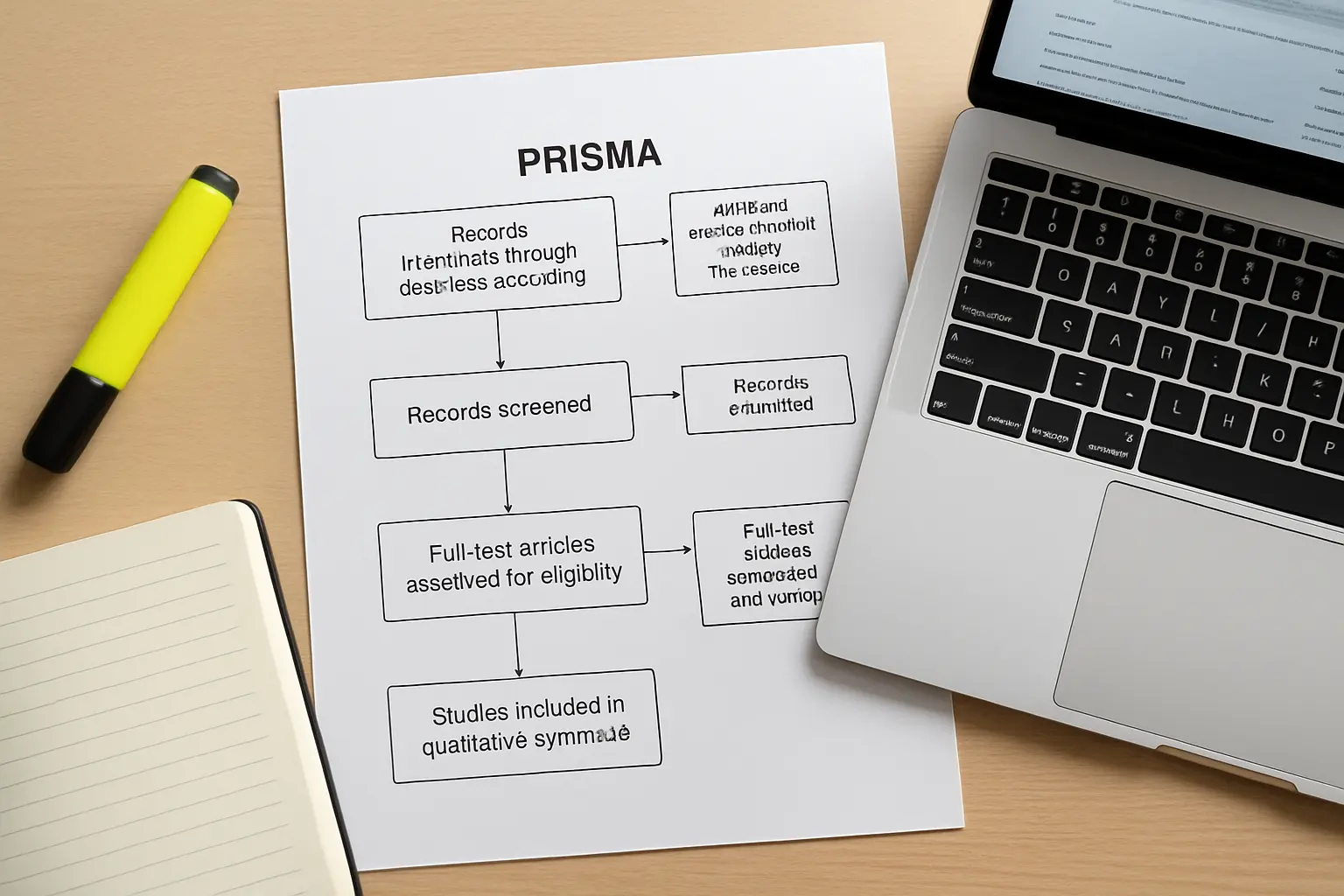
A workshop built for this cohort, not adapted from a generic “how to use the library” session, covers four things in sequence: (1) translating a research question into a search strategy with field-specific controlled vocabulary — communication research uses different subject-heading language across EBSCO, Web of Science and Scopus, and a student who does not know this will run three inconsistent searches and believe they agree; (2) documenting the strategy so it survives supervisor and examiner scrutiny — string, date range, limiters and the database version searched, in a format that mirrors PRISMA reporting even for a review that is not a formal systematic review; (3) choosing a reference manager for the faculty matched to the required citation style, so screening and citing happen in the same tool rather than two; and (4) where a review needs content-analysis or discourse-analysis software rather than a citation database at all, because a chunk of Communication and Journalism theses are not literature reviews of prior scholarship but analyses of a media corpus, and that is a different library-adjacent skill entirely.
The workshop is best co-taught: the subject librarian owns the database mechanics, and a supervisor or the graduate programme director frames what “good enough” looks like for that faculty’s expected review length and depth. Librarians teaching this alone tend to over-index on exhaustive search technique; supervisors teaching it alone tend to under-specify the mechanics and assume students already know how to run a database search competently, which is frequently not true even at doctoral level.
Review-length and screening-volume benchmarks by review type
Not every Communication or Journalism thesis chapter called a “literature review” is doing the same job, and the amount of library support it needs scales very differently by type. There is no single published cross-institutional benchmark for this — it is not a metric HESA, IPEDS or Destatis collect, because “literature review” is not a reportable unit in any national higher-education statistics framework. What follows is a working illustration a graduate school can adapt against its own thesis archive, not an external published figure:
| Review type | Illustrative screening volume | Reporting convention | Library support implied |
|---|---|---|---|
| Traditional narrative review (typical master’s chapter) | 30–80 sources hand-selected, not formally screened | No PRISMA flow diagram expected | One search-strategy consultation, no dual-screening support |
| Scoping review (increasingly common in media-effects and platform-governance topics) | Several hundred records identified, roughly a tenth retained after screening | PRISMA-ScR flow diagram expected by most examiners | Search-strategy consultation plus a documented, exportable search string |
| Systematic review (rare at master’s level in this field, more common in doctoral work bridging health or political communication) | Several hundred to low thousands of records identified | Full PRISMA 2020 flow diagram, protocol registration increasingly expected | Search-strategy consultation, dual-screening tool access (Rayyan or Covidence), and a second reviewer |
The numbers in the table are illustrative starting points for a graduate school to test against its own past theses, not a published external benchmark — treat them as a discussion tool with your library director, not a citable statistic.
A staffing model that actually holds under cohort load
Three adjustments move a library from reactive to able to sustain a cohort: assign one named subject librarian specifically to Communication/Journalism thesis support during the review-writing window, rather than leaving it inside a shared multi-department liaison role for that period; move the search-skill workshop from optional to a scheduled cohort session tied to the proposal-approval milestone, so every student gets it at the point they need it rather than by self-selection; and set an explicit escalation path for dual-screening and protocol-registration support, because that need is real but rare enough that it should not sit in the standard consultation queue. Sizing the librarian allocation correctly starts with knowing how many students are actually in the pipeline — see postgraduate enrolment by field of study for how a Communication cohort compares with other faculties.
None of this requires new database subscriptions in most cases — Communication & Mass Media Complete, Web of Science or Scopus, and JSTOR cover the large majority of what a Communication or Journalism thesis needs. The gap is almost always staffing time and scheduling, not licensing, which is the same conclusion reached from the demand side in how much your writing centre is actually used.
Grey literature and news archives the database table above does not cover
A meaningful share of Communication and Journalism theses need sources no academic database indexes at all: news archive text for a discourse or framing analysis, trade-press coverage of a media industry shift, or regulatory filings for a platform-governance chapter. LexisNexis and Factiva remain the standard tools for full-text news-archive search, and neither is bundled into a typical academic-database package — they are usually licensed separately, at a cost the library and the journalism faculty end up negotiating jointly rather than the library absorbing alone. A student who has only ever been shown Communication & Mass Media Complete will not know this class of source exists until a supervisor asks for it, which is usually too late in the review-writing window to add a new access negotiation. Naming this explicitly in the search-skill workshop, even where the institution does not currently hold a licence, prevents the review chapter from being scoped around what the library happens to already provide rather than what the topic actually needs.
The budget conversation this creates for procurement
None of the above requires a graduate school to fund new subscriptions by default — most of what a Communication or Journalism thesis review needs sits inside licences the library already holds. Where it does surface a genuine budget question is at renewal time: a concurrent-user cap sized for casual reference use will visibly fail once thirty thesis students search the same database in the same eight-week window, and that failure shows up as support tickets and workshop complaints rather than as a line item anyone flagged in advance. The practical fix is not a bigger subscription by default — it is the library and the graduate programme jointly reviewing concurrent-use logs against the cohort’s proposal-approval calendar before the renewal decision, so a capacity problem is priced deliberately rather than discovered mid-term.
Where Tesify fits
Tesify for Institutions does not replace the library’s search-strategy expertise — it sits downstream of it. Once a student has a documented search strategy and a screened source set, the Tesify Citation Engine for Institutions keeps every reference formatted to the faculty’s required style as sources are added, and supervisors reviewing the review chapter see structure and argument rather than correcting citation formatting by hand. A free departmental pilot lets a graduate school test this against one cohort’s review-writing window before any procurement commitment.
Frequently asked questions
Should the library or the graduate programme own the search-skill workshop?
Co-taught works best. The subject librarian owns database mechanics and controlled vocabulary; the graduate programme director or a supervisor frames the expected depth and length for that faculty’s theses. Run separately, each side tends to over- or under-specify the standard.
Does a Communication or Journalism thesis need a formal systematic review with a PRISMA flow diagram?
Rarely at master’s level. Most Communication and Journalism theses use a traditional narrative or scoping review. Formal systematic reviews with full PRISMA 2020 reporting are more common in doctoral work that bridges into health communication, political communication or platform-governance research with an evidence-synthesis component. The screening and dual-review workload this creates is comparable to what a health faculty already resources — see how a health faculty supports systematic-review dissertations for the staffing model.
Is Scopus or Web of Science the better primary search tool for this field?
Neither is sufficient alone, and running both as duplicate primary searches wastes student time. Communication & Mass Media Complete or Communication Source should be the field-specific primary search; Web of Science or Scopus (whichever your institution licenses) serves as the citation-network cross-check, not a second primary search.
What causes JSTOR to under-serve a current-literature review in this field?
JSTOR’s moving-wall embargo typically excludes the most recent three to five years of a journal’s content. A student relying on JSTOR alone for a review of current media-effects or platform-governance literature will systematically miss recent scholarship.
Does dual-screening software need a new subscription?
Free tiers of dual-screening tools such as Rayyan cover most single-reviewer or small-cohort use; a paid institutional tier is only needed once genuine systematic-review volume across several theses a year justifies it.
How does a graduate school measure whether the library support is actually working?
Track it internally against your own thesis archive rather than an external benchmark: consultation wait time against the proposal-approval date, and whether examiners’ reports flag search-strategy gaps in the review chapter. Neither is a published national statistic, so the comparison that matters is your own faculty’s data year over year.
Do LexisNexis or Factiva need to be licensed for every Communication and Journalism thesis?
No. Only theses working with news-archive full text, discourse analysis of coverage, or trade-press material need them. Naming them in the workshop even without a current licence lets a student flag the need early enough for the library to negotiate short-term access rather than scoping the topic around what is already available.
Who should approve a scoping or systematic review protocol before screening begins?
The supervisor approves the research question and inclusion criteria; the subject librarian signs off on the search strategy itself. Neither substitutes for the other — a methodologically sound protocol with a weak search strategy, or a comprehensive search strategy answering the wrong question, both produce a review an examiner will challenge.