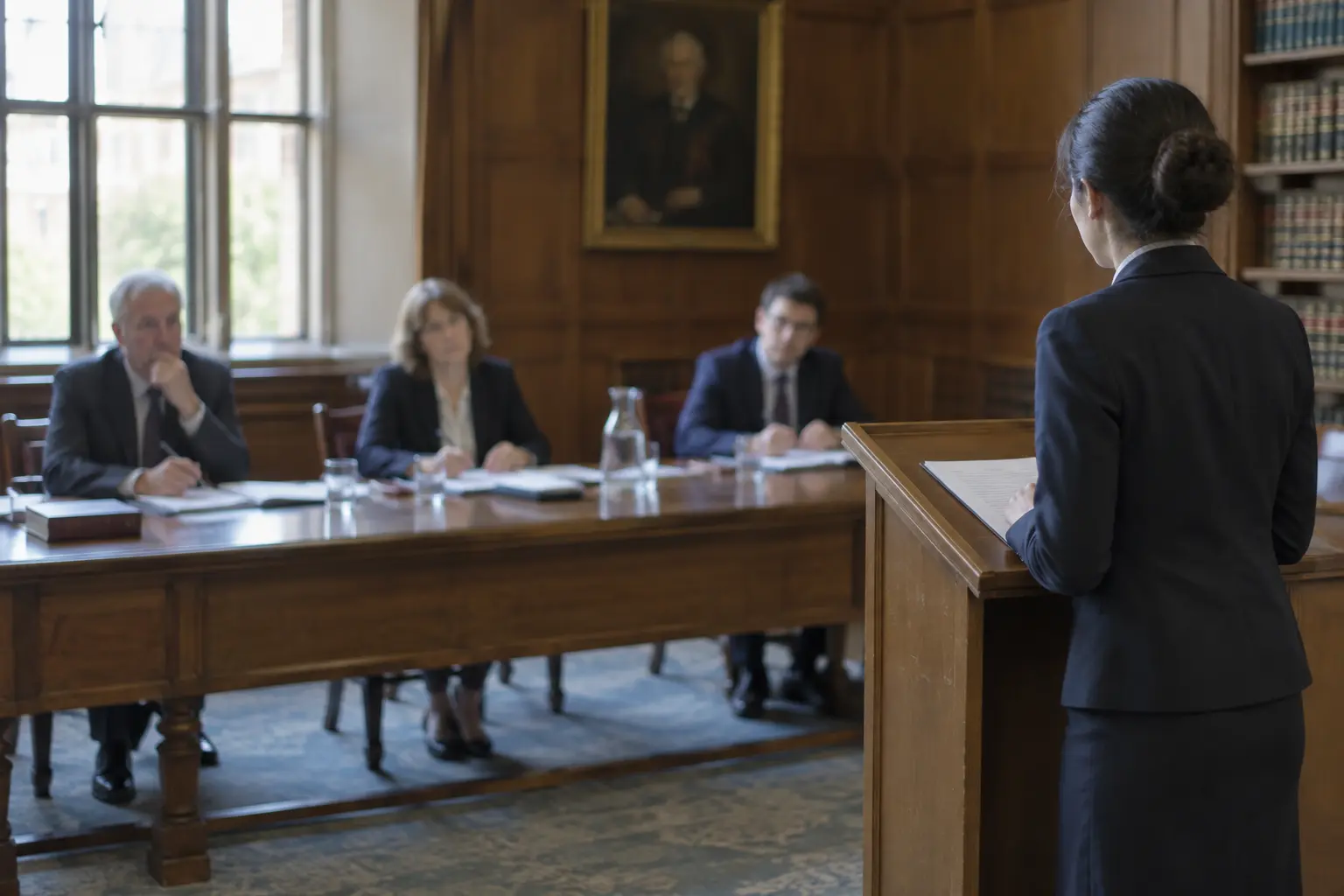
A law thesis viva works best structured as two distinct, separately scored phases: an academic-defence phase testing the written argument’s doctrinal soundness and use of authority, and a moot-style oral-advocacy phase testing whether the candidate can argue their own thesis position persuasively under live, adversarial-style questioning. Conflating the two into one undifferentiated oral examination obscures which skill a struggling candidate actually needs to develop, and rewards confident recitation over genuine argumentative defence.

Why the two phases need to be separated, not blended
A traditional academic viva — the panel asks questions, the candidate answers, the panel deliberates — tests whether the candidate understands and can explain their own written argument. It does not, by itself, test something a legal career specifically demands: the ability to hold a position under sustained, adversarial pressure from someone actively trying to find the weakest point in it, in real time, without the benefit of a further redraft. A moot-style segment, borrowed deliberately from the format law students already train in through moot court, tests exactly that skill, and testing it separately from academic defence means a panel can score a candidate’s doctrinal command and their live advocacy as two distinct results rather than one blended impression that tells nobody, including the candidate, which skill needs work.
Phase one: academic defence of the written argument
The first phase runs closer to a conventional viva: the panel questions the candidate on the thesis’s doctrinal claims, its use and interpretation of case law, statute and secondary authority, its methodology where the thesis is comparative or empirical, and its engagement with the strongest counter-arguments already available in the literature. The goal here is establishing that the candidate understands their own argument’s foundations well enough to explain, defend and, where genuinely warranted, qualify it. This phase should conclude with the panel confirming, at minimum, that the thesis’s central claims are the candidate’s own original contribution and that they can explain how each authority cited actually supports the specific proposition it is cited for — a check that also serves as a natural, low-friction integrity safeguard, since a candidate unable to explain their own citations in their own words is a signal worth the panel noting regardless of the eventual outcome.
Phase two: moot-style oral advocacy
The second phase is structurally different: rather than the panel asking about the thesis, one or more panel members adopt an adversarial posture and press the candidate to defend their central thesis position against the strongest available counter-argument, live, with limited preparation time between challenges. This is not a debate the candidate is expected to concede — the object is testing whether they can hold their own reasoning together under real pressure, adapt an argument on the fly without abandoning its structure, and respond to a genuinely difficult question rather than a pre-rehearsed one. A candidate who performs well in phase one but struggles here is not failing the thesis’s scholarship — they are showing a gap between writing a position and defending it live, which is worth identifying explicitly rather than folding into a single overall grade that obscures the distinction.
Panel composition
At minimum, two academic examiners with doctrinal expertise in the thesis’s subject area, at least one of them external to the candidate’s own institution to guard against the same institutional-blind-spot risk this site’s piece on consistent marking of extended written work discusses for the marking stage generally. A practising lawyer or judge as a third panel member specifically strengthens the moot-style phase — someone who cross-examines and challenges arguments professionally brings a different, valuable pressure-testing style than two academics questioning each other’s former student — though this is not universal practice across institutions and should be decided against the faculty’s own resourcing and convention, not assumed as a fixed requirement.
Time-boxing and scoring the two phases separately
There is no single correct duration for either phase — practice genuinely varies by institution and jurisdiction, and this piece does not assert a specific figure it has not verified against a named institution’s own regulations. What matters more than the exact minutes allocated is that the two phases are named, time-boxed and scored separately on the examiner report, rather than blended into one open-ended conversation that produces a single undifferentiated impression. A scoring sheet with distinct sections for doctrinal command (phase one) and live argumentative resilience (phase two) gives the panel a defensible basis for its eventual recommendation and gives the candidate specific, actionable feedback on which skill needs development if the outcome is a referral or resubmission.

Preparing candidates for the moot-style phase
Because the moot-style phase tests a skill distinct from writing, preparing for it is also distinct from redrafting the thesis further. A faculty running this structure well typically offers, ahead of the viva date, a mock cross-examination session run by a different member of staff than the candidate’s own supervisor — the same independence logic this site’s piece on structuring a proposal-review workflow applies at an earlier stage, for a different reason: a supervisor too close to the thesis’s development is a weaker source of genuinely difficult, unanticipated counter-arguments than a colleague encountering the argument for the first time. The candidate’s own moot-court training, if their programme includes one, transfers directly here — the format is deliberately familiar rather than a novel examination style invented specifically for the thesis stage. Candidates who have not had recent moot-court practice benefit from an explicit briefing on what phase two is testing, since walking in expecting a conventional viva and encountering adversarial cross-examination instead is itself a source of avoidable underperformance unrelated to the underlying quality of the thesis.
Common failure modes examiners report
- Accurate recitation without live defence. The most frequently reported gap: a candidate who can restate their thesis’s argument accurately, sometimes word for word, but cannot respond to a genuinely adversarial counter-argument raised live, because the written argument was rehearsed rather than internalised as something they can reason from.
- Conceding too early under pressure. A candidate who abandons a defensible position at the first sign of panel pushback, rather than distinguishing a genuinely fatal objection from a challenging-but-answerable one — itself a skill worth coaching before the viva, not just assessing at it.
- Treating phase two as a debate to win outright. The opposite failure — a candidate who refuses to concede any point at all, even a minor, genuinely valid one, mistaking rigid defence for strong advocacy. Acknowledging a fair point while maintaining the overall thesis position is itself the skill being assessed, not blanket resistance.
- Panel drift back into phase-one questioning during phase two. Examiners themselves sometimes slide back into doctrinal clarification questions once the moot-style phase begins, diluting its distinct purpose. A named phase transition — explicitly announced by the chair — helps keep the two phases genuinely separate in practice, not just on paper.
Does this apply below doctoral level?
The two-phase logic scales down conceptually to a taught-master’s or undergraduate law dissertation, but many programmes at those levels do not include a formal oral defence at all, relying instead on the written submission alone. A faculty considering introducing any oral-defence element below doctoral level should confirm first against its own degree regulations whether a viva is currently required, optional, or absent, rather than assuming this structure applies uniformly across every level of law degree the faculty offers.
How this differs from the site’s other viva-structuring pieces
This site has covered viva structuring for two other fields: a Data Science/AI thesis viva panel, where the core challenge is examining a candidate whose research object is a model rather than the candidate’s own drafting process, and a clinical thesis viva with an OSCE-adjacent component, where the added element is case-based clinical reasoning under simulated pressure. Law’s moot-style oral-advocacy phase is a structurally similar idea — add a discipline-native, pressure-tested component to a conventional academic viva — applied to law’s own native format rather than borrowed from data science or clinical medicine. Each field’s added component should come from that field’s own professional practice, not be copied wholesale from another discipline’s solution.
Where Tesify fits
Viva format, panel composition and scoring rubric design stay with the faculty’s own examination board — no platform makes those calls. Where Tesify for Institutions is relevant is earlier, during drafting: giving a supervisor visibility into whether a candidate’s written argument, and their engagement with the strongest counter-arguments in the literature, is developed enough by submission that the phase-one academic defence is unlikely to surface a doctrinal gap the candidate has not already anticipated. A free departmental pilot lets one law cohort test that visibility before any procurement decision.
Frequently asked questions
How should a law faculty structure a thesis viva or moot-style defence?
As two distinct phases scored separately: an academic-defence phase testing the written argument’s doctrinal soundness and use of authority, and a moot-style oral-advocacy phase testing whether the candidate can argue their own thesis position persuasively under live, adversarial-style questioning.
Why separate academic defence from oral advocacy in a law thesis viva?
Because they test different skills. A candidate can have written a doctrinally excellent thesis while struggling to defend it persuasively under live questioning, or vice versa — conflating the two into one undifferentiated score obscures which skill actually needs development.
Who should sit on a law thesis viva panel?
At minimum, two academic examiners with doctrinal expertise in the thesis’s subject area, one of whom is external to the candidate’s own institution. A practising lawyer or judge as a third panel member strengthens the oral-advocacy phase specifically, though is not universal practice.
How long should each phase of the viva last?
There is no single correct length — practice varies by institution and jurisdiction — but keeping the two phases named and time-boxed separately, rather than blending them into one open-ended conversation, makes the panel’s eventual scoring more defensible.
What is the most common failure mode examiners report in a law thesis viva?
A candidate who can recite their thesis’s argument accurately but cannot respond to a genuinely adversarial counter-argument raised live — the gap between having written a position and being able to defend it under real-time challenge.
How should a candidate prepare specifically for the moot-style phase?
Through a mock cross-examination session run by a staff member other than their own supervisor, since a supervisor too close to the thesis is a weaker source of genuinely unanticipated counter-arguments. Candidates without recent moot-court experience benefit from an explicit briefing on what the phase is testing before the viva date.
Does this structure apply to an undergraduate law dissertation as well as a doctoral thesis?
The two-phase logic scales down, but many undergraduate and taught-master’s law dissertations do not include a formal oral defence at all — a faculty should confirm this against its own degree regulations before assuming a viva applies.