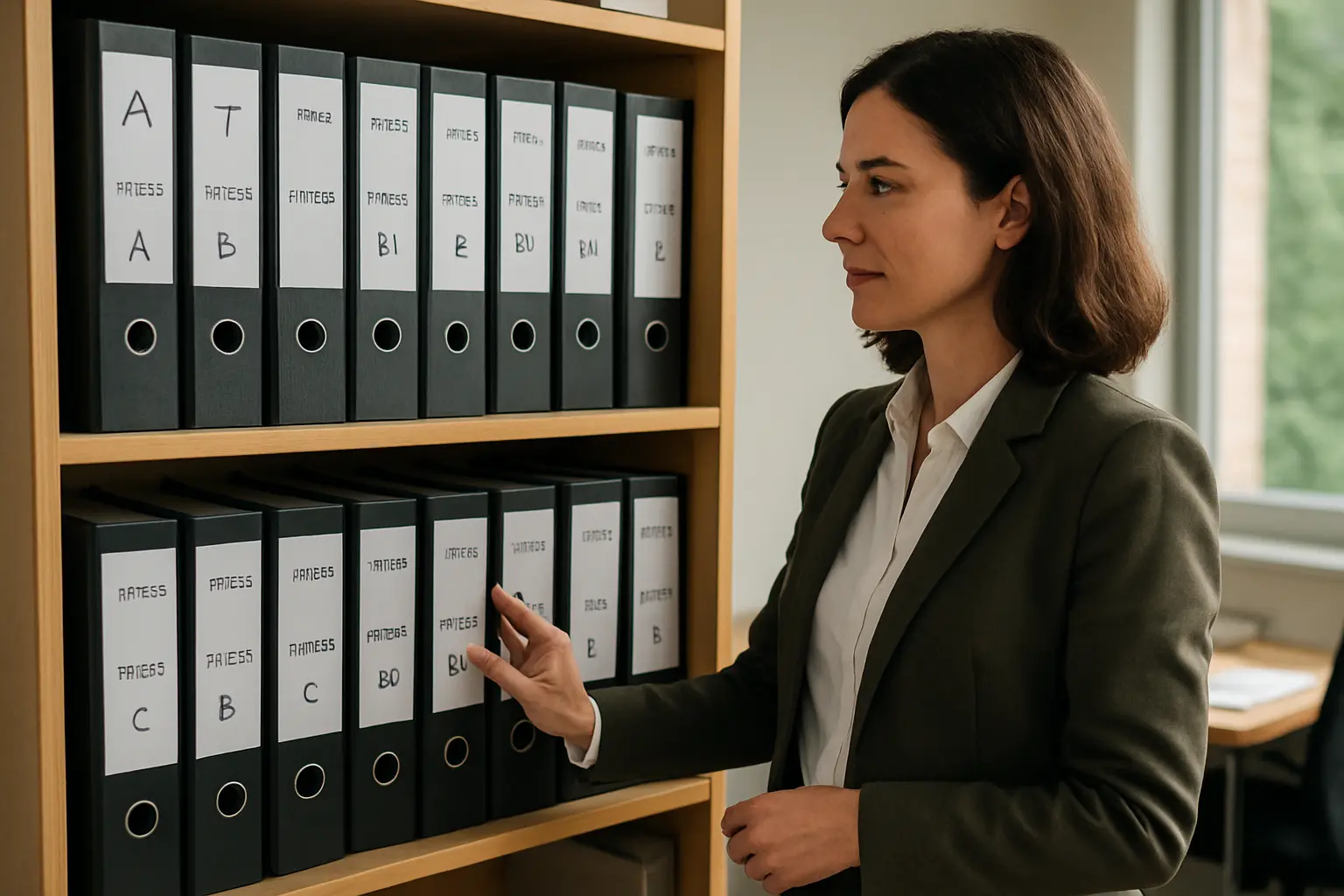
A marketing faculty that has never assembled a curated set of model theses is asking every new supervisor and every new cohort to reconstruct, from scratch, what a strong marketing dissertation actually looks like. Seven steps to build and govern an exemplar library that survives consent, IP and academic-integrity scrutiny — not just a folder of last year’s best submissions.
Step 1: Decide what the library is for before choosing which theses go in it
Owner: programme lead. Artefact: a one-paragraph purpose statement.
An exemplar library built to show students “what a distinction looks like” is a different collection from one built to calibrate supervisor and marker judgement, and the two purposes pull toward different selection criteria. A library aimed at calibration needs a spread across grade bands — a solid pass, a good 2:1-equivalent, a distinction — annotated with what separated each tier, because a marketing faculty’s actual recurring problem is inconsistent marking on borderline scripts, not a shortage of top-end examples for students to admire. A library aimed purely at student inspiration can skew toward the strongest work alone. Most faculties need both, but building the collection without deciding which purpose is primary produces a library that serves neither well.
Step 2: Set selection criteria specific to marketing’s own methodological spread
Owner: research-methods module convenor. Artefact: a selection checklist by project type.
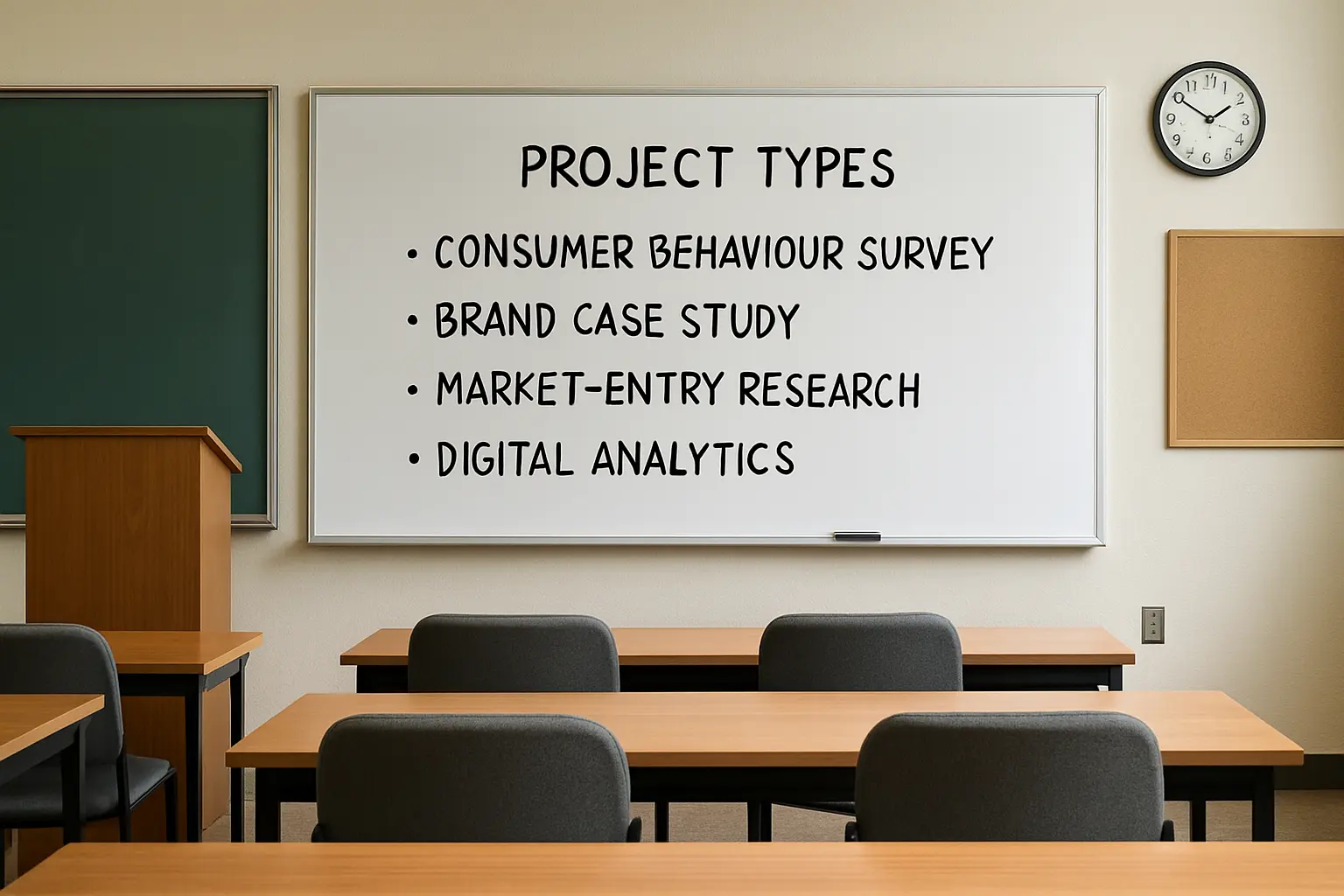
A marketing dissertation cohort splits across genuinely different project types more than most business disciplines: a quantitative consumer-behaviour survey with structural-equation or regression analysis; a qualitative or case-study evaluation of a single brand’s campaign; a mixed-methods brand-equity or market-entry study; and, increasingly, a digital-marketing analytics project built on platform data (social engagement metrics, A/B test results, campaign performance dashboards) rather than a conventional primary survey. A library that only holds quantitative-survey exemplars leaves every qualitative and digital-analytics student without a model that matches their own project’s structure. The selection checklist should require at least one strong exemplar per project type each cycle, not a fixed total count regardless of mix.
A worked example: sizing the library to a real cohort
Consider a marketing faculty running a taught-masters dissertation cohort of 150 students a year, split roughly 45 percent quantitative consumer-behaviour or brand-equity survey projects, 25 percent qualitative or single-case brand and campaign studies, 20 percent mixed-methods market-entry or positioning research, and the remaining 10 percent digital-marketing analytics projects built on platform or campaign-performance data. Under the “three to five exemplars per project type, spanning the grade bands” guidance below, that cohort needs roughly 12 to 20 annotated exemplars in total to cover every project type at every grade band — a collection well within what a single module convenor can curate and maintain, provided the selection and annotation work is scheduled rather than left to happen opportunistically whenever a strong thesis happens to be noticed. The proportions matter more than the total: a faculty that builds its library from whichever theses a supervisor happened to keep tends to over-represent whichever project type that supervisor personally favours, usually the conventional quantitative survey, leaving the growing digital-analytics cohort with no matching model at all.
Step 3: Get consent before reusing a student’s thesis as a teaching exemplar
A completed thesis is not automatically the faculty’s to redistribute as a teaching resource. As set out in who owns a student’s thesis on a university platform, the student is the author and holds copyright; the institution typically takes a non-exclusive licence as a condition of the degree, which covers examination and archiving but does not automatically extend to republishing the work as a training document for future cohorts. A workable consent model asks graduating students, at the point of final submission, whether their thesis may be used as an anonymised or attributed exemplar in future teaching, with a clear opt-out and no consequence for declining. Retroactively pulling a strong thesis from the archive without this consent step is the single most common way an exemplar library creates an avoidable grievance.
Step 4: Annotate every exemplar rather than filing it raw
Owner: module convenor, with input from the original supervisor where available. Artefact: a one-page annotation sheet per exemplar.
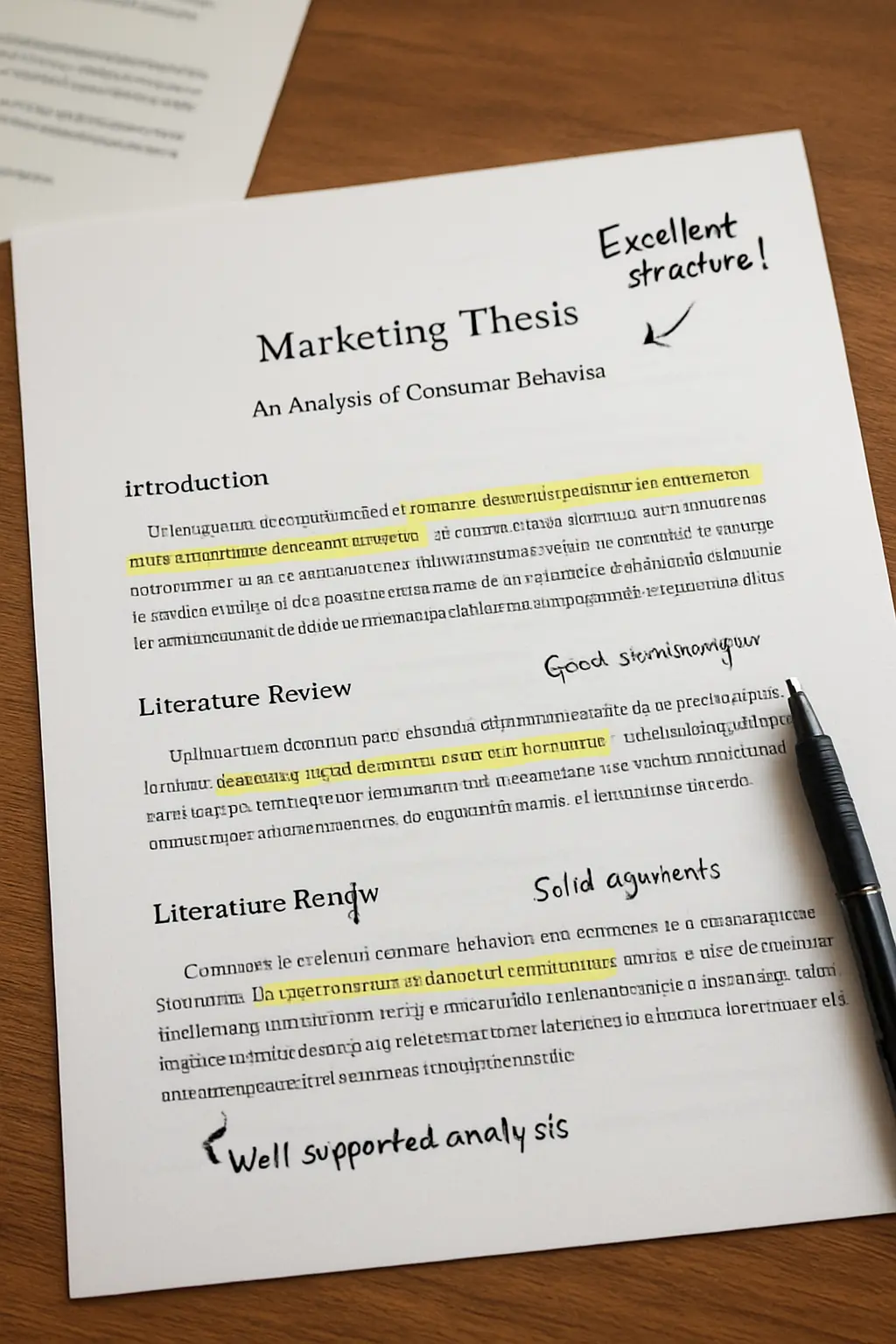
A raw thesis, however strong, teaches by imitation and leaves the reasoning implicit. A short annotation sheet attached to each exemplar — what the research question achieves that a weaker version would not, why the chosen method fits a consumer-behaviour or brand-strategy question specifically, and which section an external examiner singled out in feedback — converts a passive reading exercise into an active one. This is the same underlying logic set out for calibration generally in how to get consistent marking on extended written work: criteria specific enough that two readers apply them identically, taught before the work is produced rather than corrected after. An exemplar library without annotation is a much weaker version of the same fix.
Step 5: Assign a named curator and a review cycle, not an ad hoc folder
Owner: associate dean for education. Artefact: a curator role description and an annual review date.
An exemplar library that nobody owns decays quickly: submissions from a marking scheme five years out of date, a project-type mix that no longer matches what the department actually sets, dead links to a defunct shared drive. Naming a curator — usually the research-methods module convenor, since they see every cohort’s output and the current marking criteria together — and setting an annual review date tied to the end of each marking cycle keeps the collection current. The review should explicitly ask: which project types were under-represented this year, and which existing exemplars now reflect a superseded marking scheme or a methodology the department no longer teaches in the same way.
Step 6: Control access the way you would any other assessment material
Owner: IT or learning-technology lead, on the module convenor’s instruction. Artefact: an access-control setting inside the institution’s existing VLE.
An exemplar library holding real, identifiable or pseudonymised student work should sit inside the institution’s existing virtual learning environment, restricted to the current cohort and teaching staff, not posted to an open department website where it can be indexed, scraped or reused outside the consent given. This is a smaller-scale version of the same access-governance question already answered for the platform generally in how to run a departmental pilot of an AI writing tool — access should be scoped to the people the consent was actually given for, and no wider.
A practical access model most faculties can implement without new procurement is a dedicated, permissioned folder or module area inside the VLE the cohort already uses, visible only to enrolled students on the current dissertation module and the teaching team, rather than a standing archive visible to every future cohort by default. Rolling access forward automatically, without a fresh check against each exemplar’s consent terms, is how a library that started narrowly scoped drifts into something broader than any individual author agreed to — a lightweight annual access audit, run at the same time as the Step 5 content review, catches this before it becomes a genuine complaint rather than a theoretical risk.
Step 7: Treat the library as a moderation tool, not just a teaching resource
The same collection that helps students see what strong marketing research looks like is equally useful for training a new or visiting marker: circulating two or three annotated exemplars at each grade boundary before a marking period starts is a low-cost calibration exercise that most marketing programmes currently skip entirely, relying instead on markers’ individual, uncalibrated sense of what a given grade requires. A library built with Step 1’s dual purpose in mind serves both jobs from the same underlying collection, rather than requiring two separate efforts.
Common failure modes that undermine an exemplar library
Three failures recur even at faculties that formally commit to building one. First, the library launches with a strong initial batch and then stops growing, because no one owns the annual refresh once the founding module convenor moves on — the curator role in Step 5 needs to be attached to the position, not the person, with a documented handover. Second, the annotation gets skipped under time pressure and the “library” quietly reverts to a raw folder of past submissions, which is the version Step 4 exists specifically to prevent; a library that has drifted back to unannotated raw files should be flagged and fixed at the next review rather than left as is because something is better than nothing. Third, consent is treated as a one-time blanket clause buried in the programme handbook rather than an explicit, revisitable choice at submission — a student who agreed to exemplar use as an anonymised excerpt does not thereby consent to their full thesis, with their name attached, circulating indefinitely; re-confirming consent periodically, particularly before a longstanding exemplar’s tenth year in rotation, is a defensible practice most libraries skip.
The same seasonal cohort pressure documented in the masters dissertation season capacity cliff is exactly when an exemplar library earns its keep: a supervisor facing an entire cohort’s worth of proposals in the same eight-week window has far less time to explain, project by project, what a strong version of each project type looks like, and a well-curated library absorbs part of that explanatory load without consuming additional supervision hours.
Where Tesify fits
Building the library itself is a curation task Tesify does not automate — the selection and annotation judgement stays with your own module convenors and supervisors. Where it helps is standardising the reference and citation formatting across every exemplar you archive, so a library built over several years does not mix house styles: the Tesify Citation Engine for Institutions applies one consistent citation style across a faculty’s archived work, and students using the main Tesify for Institutions platform draft against the same house style the exemplar library teaches. A free departmental pilot lets one cohort test the annotated-exemplar approach before any procurement decision.
Frequently asked questions
How many exemplars does a marketing faculty actually need?
Fewer than most faculties assume — three to five per project type, spanning the grade bands, is usually enough to be useful. A much larger, unannotated archive is harder to maintain and less effective than a small, well-annotated one.
Should the library only include distinction-level work?
Not if the purpose includes marking calibration. A library of only top-band work cannot show markers or students where a solid-pass or 2:1-equivalent script differs from a distinction, which is where most marking inconsistency actually happens.
Do students need to consent before their thesis is used as an exemplar?
Yes. Holding copyright as the author, a student’s non-exclusive licence to the institution does not automatically cover republishing the work as a teaching resource for future cohorts — ask at submission, with a genuine opt-out.
Who should annotate the exemplars?
Ideally the module convenor with input from the original supervisor, since the annotation needs to explain grading reasoning, not just describe the content.
Should the library be public or restricted to the current cohort?
Restricted, inside the institution’s existing VLE. Open publication risks reuse outside the scope of the consent given and can expose the work to indexing or scraping.
How often should the library be reviewed?
Annually, tied to the end of each marking cycle, checking for under-represented project types and exemplars that now reflect a superseded marking scheme.
Can the same library serve both students and markers?
Yes, if it is built with both purposes in mind from the start — a grade-spread, annotated collection serves student learning and marker calibration from the same underlying set.
What is the biggest risk in building this without a plan?
Reusing a strong thesis without the author’s consent, which is the most common and most avoidable source of grievance once a library like this exists.