
| Platform | Category | Committee-routing model | Typical buyer | Where it sits in the research-compliance stack |
|---|---|---|---|---|
| Cayuse (Human Ethics / IRB) | Compliance-suite module | Configurable workflow across IRB, IACUC, COI and biosafety from one platform | Research offices wanting one vendor across multiple compliance domains | Broadest scope; IRB is one module in a shared compliance suite |
| Huron Click | Dedicated research-administration suite | Protocol submission and committee routing built for research-office workflows | Large research universities with dedicated IRB offices | Long-established in US research administration; often paired with grants/COI modules from the same vendor |
| IRBManager | IRB-focused platform | Web-based protocol submission, review and renewal tracking | Institutions wanting an IRB-specific tool rather than a full compliance suite | Narrower scope than Cayuse or Click; IRB is the primary product, not one module among several |
| InfoEd (IRB module) | Research-administration suite | Protocol routing integrated with the vendor’s wider grants and compliance modules | Institutions already using InfoEd for grants administration | Value depends on whether the faculty already runs InfoEd elsewhere |
A nursing faculty running a placement-based thesis cohort of a hundred or more students a year is not shopping for the same thing a hospital-wide research ethics committee needs. The committee needs a platform that can move a low-risk, anonymised-data quality-improvement project through review in days, not weeks, while still routing genuinely higher-risk clinical projects through full review — and the four platforms above are scored here on how well they support that specific tiering job, not on which has the longest feature list.
Why a nursing faculty’s IRB software decision is different from a hospital’s

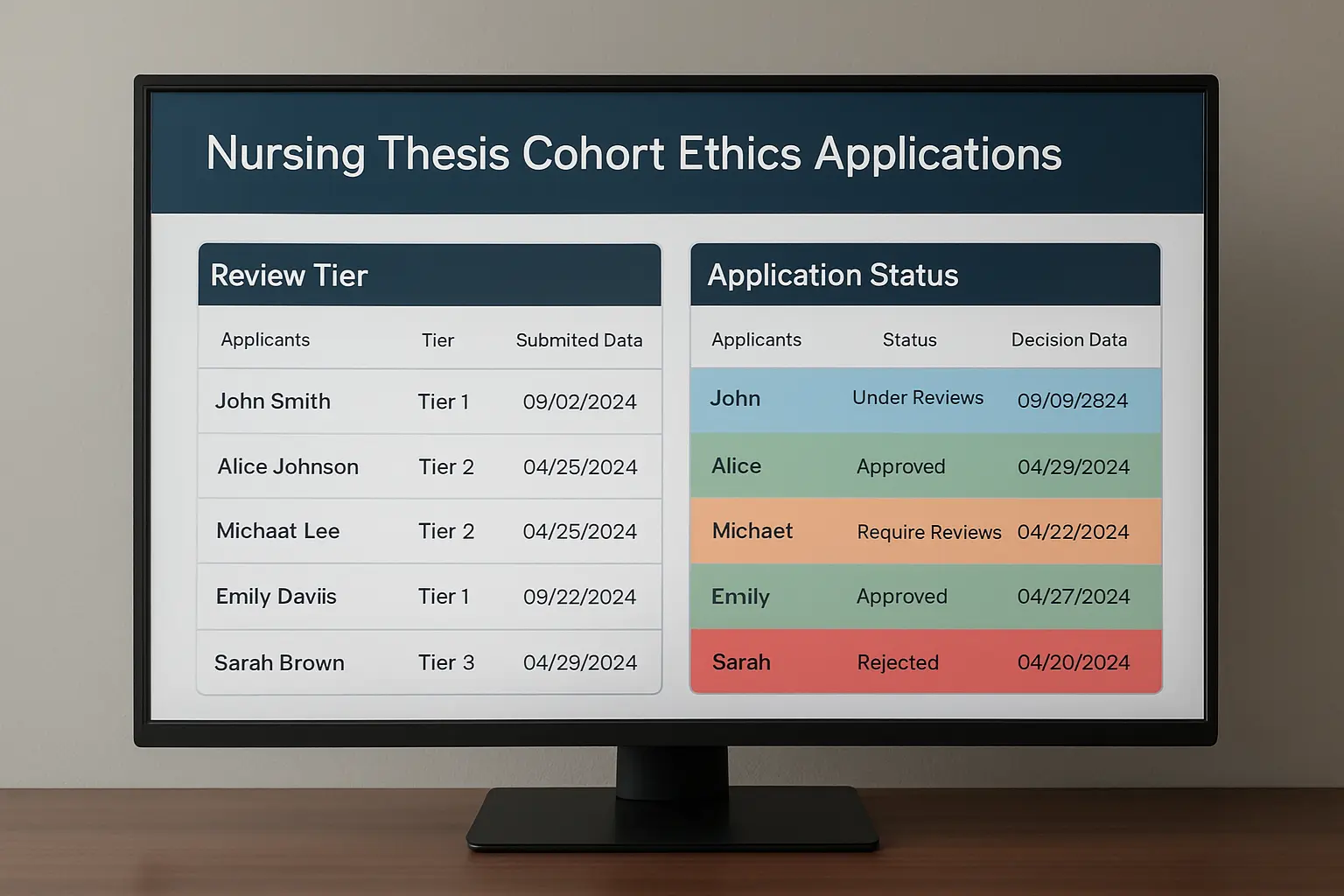
A hospital-wide research ethics committee reviews a relatively small number of staff-led studies a year, each significant enough to justify individual, full-committee attention. A nursing faculty running an annual placement-based dissertation cohort faces the opposite shape of problem, set out in more detail in how a medical school should scale ethics committee review for a thesis cohort: a large volume of mostly low-risk student projects arriving in the same narrow submission window, where the software’s ability to route the genuinely low-risk majority through a lightweight, self-certified or departmentally-reviewed track — without every project consuming full-committee time — matters more than any single advanced feature. A platform evaluation built around a hospital’s use case will over-weight capabilities (complex multi-site protocol coordination, adverse-event reporting depth) that a faculty-level student cohort rarely needs, and under-weight the tiered-routing and bulk-status-tracking capability that determines whether the office can actually clear the cohort on time.
The four evaluation criteria that actually matter at faculty scale
1. Tiered routing configurability. Can the platform be configured to route a project to a lightweight review track based on answers the student gives at submission (no new patient contact, fully anonymised secondary data), without a staff member manually triaging every single application first? This is the single highest-leverage capability for a faculty running the volume a placement-based cohort produces.
2. Bulk cohort visibility. Can an administrator see, at a glance, where every application in a 100-plus student cohort currently sits in the review pipeline, rather than checking applications one at a time? A platform without a cohort-level dashboard forces the office to maintain a separate tracking spreadsheet alongside the software, which defeats much of the point of buying it.
3. Template and consent-form management. Does the platform let the office publish and enforce use of pre-approved, field-specific consent and information-sheet templates, rather than accepting free-text uploads that then need manual correction? Template enforcement is where most review-cycle time is actually spent, as set out in the medical-cohort piece above.
4. Integration with the institution’s existing systems. Does the platform integrate with the SIS or LMS the faculty already uses for cohort and enrolment data, or does the office have to re-enter student information manually for every application? Where the faculty already runs a wider research-administration suite from one of these vendors for grants or other compliance domains, staying within that vendor’s IRB module usually costs less in integration effort than adopting a separate, best-of-breed IRB-only tool.
What each platform is, in plain terms
Cayuse markets its research-compliance offering as a single suite spanning IRB, IACUC, conflict-of-interest and biosafety review, aimed at giving a research office “repeatable workflows covering the full research lifecycle” from one vendor rather than separate tools per compliance domain. For a nursing faculty that also has to manage COI disclosures or animal-research oversight elsewhere in the institution, a single-vendor compliance suite can reduce the number of logins and training sessions staff need, at the cost of the IRB module being one part of a broader product rather than a dedicated, IRB-only build.
Huron Click is a long-established name in US research administration, typically deployed at larger research-intensive universities alongside Huron’s other research-administration products (grants, COI). Where a faculty sits inside a university that already runs Huron products for grants management, extending to Click for IRB keeps the research-office technology stack under one vendor relationship, which matters more at the university-wide procurement level than at a single faculty’s.
IRBManager is positioned as a dedicated IRB-management product rather than part of a wider compliance suite, which can suit a nursing faculty (or a smaller institution) that specifically needs ethics-review workflow without also needing IACUC or COI modules bundled in. A narrower product scope is not automatically a disadvantage — it depends on whether the wider compliance-domain modules of a suite product would ever actually be used.
InfoEd‘s IRB module sits inside a wider research-administration suite most commonly known for grants and proposal management. Its main advantage for a faculty is integration depth where the institution already runs InfoEd elsewhere; adopted in isolation, purely for IRB, it offers little that a dedicated IRB-only product does not.
This is a different tooling decision from the department’s other software choices
A nursing faculty has already made several other software-procurement decisions this cycle, and it is worth being precise about how an IRB platform differs from each of them. It is not a citation or reference-management decision, of the kind already compared in the reference manager comparison for faculties — that decision is about formatting and bibliography consistency across a cohort’s written work, entirely separate from ethics governance. It is also not the same decision as the screening-software choice already covered for systematic-review dissertations in supporting systematic review dissertations in a health faculty, which names Covidence and Rayyan for literature screening and dual-reviewer conflict resolution — a genuinely different job again, upstream of ethics review and unrelated to protocol routing. Treating all three as one generic “which software should the faculty buy” question tends to produce a worse decision on each, because the evaluation criteria that matter for citation tooling, literature-screening tooling and ethics-review tooling barely overlap.
Data residency and student-data handling apply here too
An IRB platform processes personally identifiable information about research participants, and in a placement-based nursing cohort, that can include information about patients encountered during a student’s clinical placement as well as about the student themselves. The same data-residency and processing questions already set out for edtech generally in where student text is actually processed, compared across vendors apply directly to an IRB platform vendor: where is submitted protocol and consent-form data hosted, what transfer mechanism applies if the vendor is US-based and the institution is in the EU or UK, and does the vendor’s data processing agreement explicitly cover the categories of data an ethics application can contain, including in some cases patient-adjacent information a student’s placement-based project touches on. This is a due-diligence question for the procurement team and data-protection office, not something a feature comparison alone answers.
Recommendation
For a nursing faculty evaluating this purchase on its own, independent of what the wider university already runs, IRBManager or a similarly IRB-dedicated product is the more defensible starting point: the faculty’s actual problem — tiered routing and bulk cohort visibility for a large, mostly low-risk placement-based cohort — does not require the IACUC, biosafety or grants-administration breadth that Cayuse or InfoEd bundle in. Where the wider university has already standardised on Cayuse or Huron Click for other compliance domains, extending to that vendor’s own IRB module is usually the lower-friction choice, provided its tiered-routing configuration is genuinely tested against the faculty’s actual cohort volume and submission pattern before procurement, not assumed adequate from the vendor’s general marketing description.
Where Tesify fits
Selecting and configuring ethics-review software is a decision that stays with the faculty’s research office and IT procurement team — Tesify does not replace that evaluation. Once a platform is chosen, the Tesify for Institutions workspace gives supervisors visibility into a student’s drafting progress on the methodology and ethics sections of the thesis itself, which is useful for confirming that what a student has written matches what was actually approved through whichever IRB platform the faculty runs — the same approved-protocol-versus-written-methodology check already flagged as a genuine examiner concern in the medical-cohort piece above. For plagiarism and similarity screening specifically, alongside whichever IRB tool handles ethics review, the Tesify Integrity Suite for Institutions runs batch screening across a cohort rather than one submission at a time. A free departmental pilot lets one cohort test the writing-side workspace before any procurement decision on either tool.
Frequently asked questions
Does a nursing faculty need a dedicated IRB platform, or can it use the university’s existing research-ethics system?
If the university-wide system already supports configurable tiered routing and cohort-level visibility, extending it is usually more efficient than adopting a separate faculty-only tool. If it does not, or the faculty’s cohort volume is not well served by the university-wide configuration, a dedicated evaluation is worth running.
What is the single most important feature for a placement-based nursing cohort specifically?
Tiered routing configurability — the ability to route low-risk, anonymised-data projects through a lightweight review track automatically, based on answers given at submission, without a staff member manually triaging every application.
Is a broader compliance suite (Cayuse, InfoEd) better than a dedicated IRB tool (IRBManager)?
Only if the institution genuinely needs the other modules — IACUC, biosafety, COI, or grants administration. Evaluated purely on the IRB job, a dedicated product is not automatically weaker, and can be simpler to configure and support.
Does the platform choice affect how fast a cohort’s applications clear?
The platform enables or constrains the process, but the tiering policy itself — which risk categories route where — is a decision the committee makes, not something the software decides on its own. A well-configured platform executes a well-designed tiering policy faster; a poorly configured one slows down even a good policy.
How long does an IRB platform procurement and rollout typically take?
Long enough that it should not be started in the same term a cohort needs it live. Between vendor evaluation, a data-protection and security review, configuration of the tiering workflow against the faculty’s own risk categories, and staff training, a realistic runway is one to two full terms before a cohort’s applications should rely on the new system rather than the outgoing process.
Should the faculty test the platform against its own cohort data before buying?
Yes. Vendor marketing describes general capability; whether a specific tiered-routing configuration actually handles the faculty’s real submission volume and pattern is a question only a trial against real or realistic cohort data can answer.
Does switching IRB platforms disrupt an in-progress cohort?
It can, particularly mid-cycle. Most faculties time a platform change to a cohort boundary — between one intake’s full clearance and the next intake’s opening — rather than mid-review.